Showing posts with label travel. Show all posts

Monday, December 12, 2011

Endemic, Indigenous, Native, Migrant, and Introduced


Galápagos sea lion (Zalophus wollebaeki)

After four days in Quito, we flew to the Galápagos Islands for a week-long adventure on the Eclipse. Each night after dinner, the passengers gathered in the lounge where one of the naturalists on board briefed us on our excursion options for the next day, followed by an informative talk about the islands. On our first night, Naturalist Javier Cando explained ecological terms to describe how native a species is. 
Endemic: The organism is unique to one geographic location and nowhere else in the world. An endemic species may have originated here, or evolved into a separate species, or subspecies, due to geographic isolation. 
Indigenous (native): The organism occurs in the location naturally, without the aid of humans. These species are carried to the region by wind, water, or by another organism. 
Migrant: The animal travelled long distances in search of a new habitat.
Introduced: The organism is either deliberately or accidentally brought to a new ecosystem by human activity. 

We all laughed when Javier told us that he was endemic to the Galapagos Islands. I guess I can say that my sisters and I were introduced into the United States by our parents, who migrated here. 

***

I was a bit timid about using the camera my brother-in-law loaned me for this trip. Even though it was a point-and-shoot, it was the fanciest camera I had ever used. It was during this afternoon on July 29th, 2007, that marked the beginning of my love affair with the camera, and for that, I owe a great debt to my brother-in-law.

***

For our first excursion, the Eclipse cruised to Las Bachas Beach , on the north end of Santa Cruz Island. As we came close to shore, we watched a flock Frigatebirds dive for supper.

DSC00803 Galápagos frigatebirds
Frigate Birds (Fregata)

I don’t know if they were the endemic Magnificent Frigatebird (Fregata magnificence) or the smaller, native Great Frigatebird (Fregata minor)...

DSC00810 frigate bird
Frigate Bird (Fregata)

…but I do know that both species of Frigatebirds are kleptoparasitic. These rogues love to mob flocks of Blue-footed Boobies and force them to regurgitate so that their catch can be intercepted.

DSC00801 Galápagos frigate birds and blue-footed boobies
Frigate Birds (Fregata) and Blue-footed Booby (Sula nebouxii)

I was excited to explore the mossy boulders to see what I could discover. Javier told us to stay away from the moss, not only because it’s slippery, but because we are not to disturb any of the fauna or flora. Careful not to tread on any moss, I did manage to photograph this American Oystercatcher, endemic subspecies galapagensis. This uncommon resident has only around 200 pairs in the Galápagos Islands. 

DSC00804 American Oystercatcher
American Oystercatcher (Haematopus palliatus galapagensis)

DSC00808 American Oystercatcher
American Oystercatcher (Haematopus palliatus galapagensis)

A Yellow Warbler hopped between the rocks picking insects off the moss.

DSC00816 yellow warbler cropped
Yellow Warbler (Dendroica petechial aureola)

Its race, aureola, is near-endemic and also known as the Mangrove Warbler.

DSC00856 yellow warbler cropped
Yellow Warbler (Dendroica petechial aureola)

Looking across the rocky shore, I occasionally saw orange dots scampering about.


DSC00830 Galapagos Sally Lightfoot Crab habitat 

The Sally Lightfoot Crab is the most common crab along the west coast of the Americas and native to the Galápagos Islands. 

DSC00822 Galapagos Sally Lightfoot Crab
Sally Lightfoot Crab (Grapsus grapsus)

John Steinbeck‘s entertaining observations about how the Sally Lightfoot Crab lives up to its name can be read here.

DSC00826 Galapagos Sally Lightfoot Crabs
Sally Lightfoot Crab (Grapsus grapsus)
DSC00831 two sally lightfoot crabs
Sally Lightfoot Crab (Grapsus grapsus)

We saw a solitary Galápagos Flamingo feeding on the far end of a saltwater lagoon when we joined Javier for brief walk. It is believed that the flamingo migrated from the Carribean and then evolved into an endemic subspecies here.

DSC00814 American Flamingo
Galápagos Flamingo (Phoenicopterus ruber glyphorhynchus)

A Galápagos Mockingbird hopped around our small group, flitting back and forth between the sandy beach…

DSC00854 Galápagos mockingbird cropped
Galápagos mockingbird (Mimus parvulus)

…and the mangrove trees. 


DSC00852 Galápagos mockingbird
Galápagos mockingbird (Mimus parvulus)

***


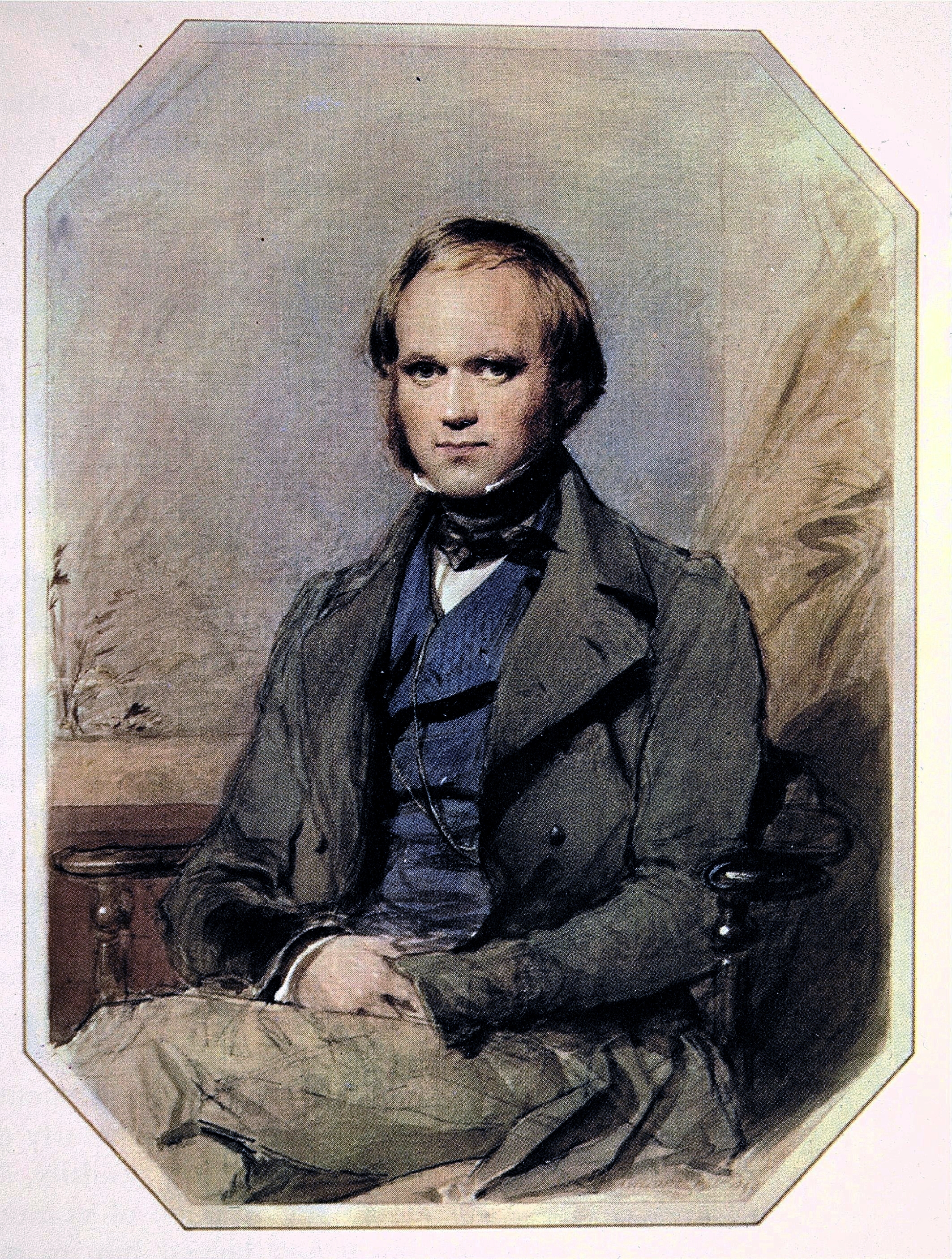
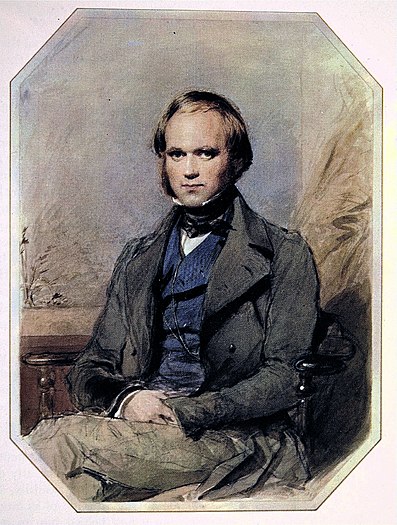
It was the mockingbird, not finches, that first caught Charles Darwin’s eye when he visited the Galápagos Islands at age 26 in 1835:
“I have specimens from four of the larger islands…The specimens from Chatham and Albemarle Isd. appear to be the same; but the other two are different. In each Isld. each kind is exclusively found. “  
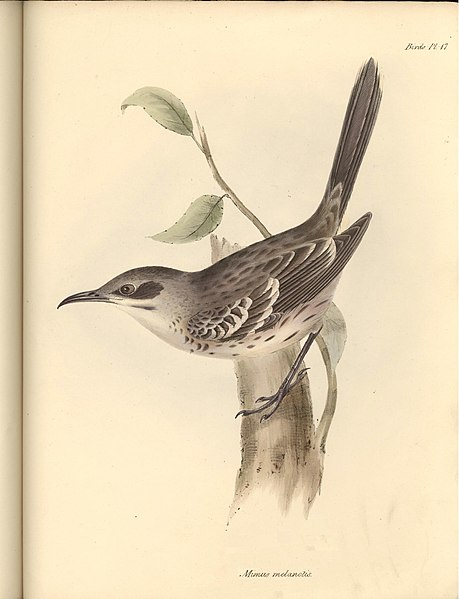
Floreana Mockingbird or Charles Mockingbird
(Mimus trifasciatus) 
San Cristobal Mockingbird or Chatham Mockingbird
(Mimus melanotis) 

Sadly, many mockingbirds were driven to extinction, or near extinction, by rats introduced to the islands by buccaneers.

When Darwin returned to England, he used his mockingbird observation as the basis for concluding that the thirteen finches he observed in the Galápagos Islands all evolved separately due to the isolation of the islands.

*** 

Early during the walk, our 13-year-old son shared with Javier that his goal was to see a marine iguana on this trip. Javier smiled and told him that this could be arranged. Imagine my son’s excitement when he saw them on his very first excursion:

DSC00866 Six marine iguanas and Sally Lightfoot crab
Marine Iguana (Amblyrhynchus cristatus)

Charles Darwin was not as enamored with them as my son was.
 “The black Lava rocks on the beach are frequented by large (2-3 ft), disgusting clumsy Lizards. They are as black as the porous rocks over which they crawl & seek their prey from the Sea. I call them 'imps of darkness'. They assuredly well become the land they inhabit.” 
I have to agree with my son; what's not to love about this remarkable creature?


DSC00858 marine iguana cropped
Marine Iguana (Amblyrhynchus cristatus)
DSC00867 marine iguana
Marine Iguana (Amblyrhynchus cristatus)

Once he saw them on land, my son's next goal to was to see them swim in the ocean. They swam gracefully, swishing their tails in smooth back and forth waves.

DSC00861 marine iguana swimming
Marine Iguana (Amblyrhynchus cristatus)

As an extra bonus, we saw a green turtle swimming nearby.

DSC00860 Green Turtle and Sally Lightfoot Crab cropped
Galápagos green turtle (Chelonia mydas agassisi) 

DSC00859 Green Turtle cropped
Galápagos green turtle (Chelonia mydas agassisi) 

The Galápagos green turtle is a subspecies of the green sea turtle we see in Hawaii. The species is indigenous, but the subspecies is endemic to the Galápagos Islands .

The same holds true for the Brown Pelican, with the amusing subspecies name urinator.

DSC00864 Galápagos Brown Pelican
Brown Pelican (Pelecanus occidentalis urinator)

DSC00864 Galápagos Brown Pelican cropped
Brown Pelican (Pelecanus occidentalis urinator)

When we returned to the beach, we sat among the Galápagos sea lions.

DSC00839 Galápagos sea lion
Galápagos sea lion (Zalophus wollebaeki)

DSC00837 Galápagos sea lion
Galápagos sea lion (Zalophus wollebaeki)


…and all cooed when we saw the baby sea lions nursing.


DSC00842 Galápagos sea lions nursing
Galápagos sea lion (Zalophus wollebaeki)

This  small beach was a great choice for our first excursion because it provided an intimate setting where the 47 passengers of the Eclipse had a chance to become acquainted with each other.

DSC00843 tourists at Las Bachas Beach
Galápagos sea lion (Zalophus wollebaeki) and Homo Sapien

Even though we Homo Sapiens are an introduced species into the Galápagos Islands, it is my sincere hope that we will not have a negative impact to the abundance of this ecology.

***

Works Cited

"File:Mimus Melanotis.jpg." Wikipedia, the Free Encyclopedia. Web. 12 Dec. 2011. <http://en.wikipedia.org/wiki/File:Mimus_melanotis.jpg>.

"File:Mimus Trifasciatus.jpg." Wikipedia, the Free Encyclopedia. Web. 12 Dec. 2011. <http://en.wikipedia.org/wiki/File:Mimus_trifasciatus.jpg>.

"Grapsus Grapsus." Wikipedia, the Free Encyclopedia. Web. 12 Dec. 2011. <http://en.wikipedia.org/wiki/Grapsus_grapsus>.

"INaturalist.org · Galápagos, EC." INaturalist.org · A Community for Naturalists. Web. 12 Dec. 2011. <http://www.inaturalist.org/places/12990>.

"Marine Iguana." Wikipedia, the Free Encyclopedia. Web. 12 Dec. 2011. <http://en.wikipedia.org/wiki/Marine_Iguana>.

Stewart, Paul. Galapagos: the Islands That Changed the World. New Haven, Connecticut, CT: Yale UP, 2007. Print.

Swash, Andy, Rob Still, and Ian Lewington. Birds, Mammals, and Reptiles of the Galápagos Islands: an Identification Guide. New Haven: Yale UP, 2005. Print.

Thursday, January 6, 2011

The Sami People of Nordkapp

IMG_4835 Nordkapp

This summer we took a cruise on the Norwegian passenger and freight line Hurtigruten ("Express Route" in English) We boarded the "Midnatsol" in Bergen and sailed for one week up to Kirkenes.  One of the last stops of our voyage was the North Cape (Nordkapp), located well north of the Arctic Circle.

One of the surprises on this cruise is that I did not spot more birds along the way. I fully expected to see many breeding grounds along the coastline, but it was surprisingly bare. I was therefore on high alert when I saw a few small dots bobbing in the water about an hour before we docked.


IMG_4822 puffin at nordkapp uncropped

A closer examination revealed that these dots were puffins. Not a great picture, but it's the only one I have.

IMG_4822 puffin at nordkapp
Atlantic Puffin (Fratercula arctica)

I had the option to take the bird safari excursion, where I would have been able to see large flocks of puffins and kittiwakes and even the mighty sea eagles, but ultimately I chose to join the rest of my family on the bus tour to see the North Cape (Nordkapp), 21 miles away, on the north side of the island of Magerøya. 

We docked in Honningsvåg, which claims to be the northernmost city in Norway, or even the world, but there are several other cities who dispute this claim. The village was occupied by the Germans in World War II; sadly, only the chapel was spared destruction. After the war,  many of the houses were restored to their original style, using the original color scheme. Historically, white was the most expensive paint color and therefore the most prestigious. Prestige or not, the white houses would not look as pristine and idyllic were it not for the occasional red and yellow structures against the bright green grass. 

IMG_4826 on the way to Nordkapp

We boarded a bus that drove us past the traditional fish racks which still had cod drying in the sun before winter sets in. 

IMG_4932 Nordkapp fish racks

We saw many more racks on the hillsides, but they had already been picked bare. 

IMG_4847 Nordkapp fish racks

The bus careened along the winding roads across the bald sub-arctic landscape of the island.

IMG_4840 Nordkapp bus view

Periodically the bus driver would point out reindeer grazing on the short grass. See if you can spot the stag and three does below. Don't worry if you can't, I had trouble seeing them too. If you're hell-bent on seeing them, you can click here . Fortunately, we did get the opportunity to see more reindeer up close only a few minutes later.


IMG_4837 Norkapp bus view

Only the indigenous people called the Sami (also spelled Sámi, or Saami) are allowed to practice reindeer husbandry in Norway. Magerøya Island can boast 5,000 reindeer, all owned by five Sami families. The reindeer are allowed to roam freely, with only minimal fencing to keep them from harm. 

DSC07820 Nordkapp fence

The tags in the ears of the reindeer indicate ownership. 

IMG_4858 reindeer numer 1069
Reindeer (Rangifer tarandus)

IMG_4855 reindeer

IMG_4854 reindeer

Both males and females grow antlers.  I was amazed how fuzzy they were (no, I did not touch them). 

IMG_4870 reindeer

To save energy, they shed them annually. On our way back to the ship, we found shed antlers offered for sale in a small Sami shop near the ship.

The bus stopped at a Sami trading post where a Sami posed with tourists in his colorful native costume. It is not difficult to imagine the seed of inspiration for Santa's elves' costumes.

IMG_4851 reindeer photo op

The Sami use a temporary shelter, called a lavvu, which is strikingly similar to the teepees of Native Americans of the Great Plains. The portability of this structure allows the herdsmen to follow their reindeer.

IMG_4930 Sami Trading Post


IMG_4867 saami tent

Traditionally the reindeer hides were used as a cover, but now lighter fabrics are used to lighten the load. The long straight poles to construct these dwellings must be prized because tall vegetative growth appears to be scarce in this region. To our surprise there was an open fire inside, but the smoke easily escapes from the smoke hole at the top. 

IMG_4865 saami tent

The interior walls were decorated with the gorgeous native attire made with generous yardage and elaborate workmanship. I can imagine how fantastic these crisp, bright colors would look in the stark white snow. 

IMG_4861 saami costume

The trousers are made of reindeer hides.

IMG_4863 saami costumes

IMG_4864 saami costumes

The style and colors used in these these garments appear to be a perfect blending of Scandinavian, Russian, and Northwest Indian cultures.  Not surprising, given that all these descend from within the Arctic Circle and the nomadic nature of the Sami people. 

Many Sami regard the term Laplander as a pejorative term. In most Scandinavian languages the word "lap" means a patch of cloth used for mending. Where one culture used a scrap of fabric out of necessity, one could see how it may be difficult to understand that another culture used them as artistic adornments. 

We had only a few minutes to take a look at the goods offered in the trading post. My sister is to be commended for finding and purchasing a splendid black wool shawl for our mother in less than five minutes.

IMG_4873 saami costumes

IMG_4874 saami accessories


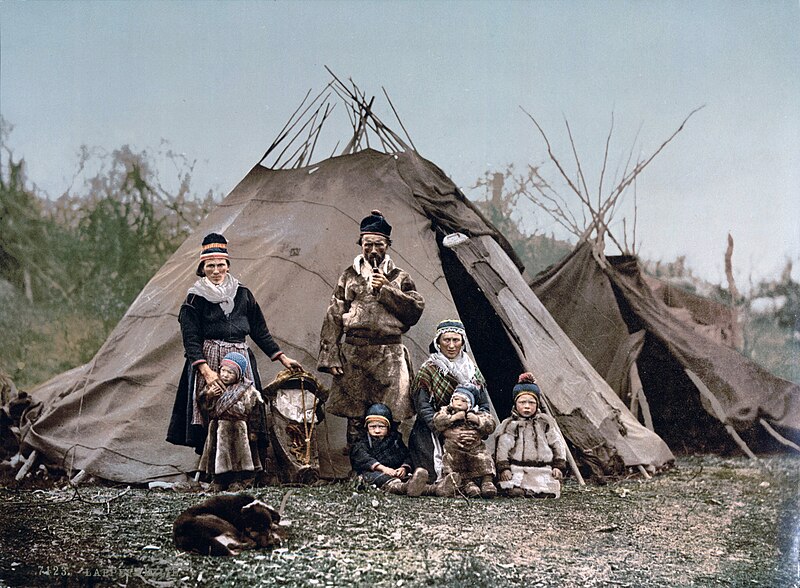
The Sami people suffered from laws of forced assimilation into the Norwegian culture, which peaked from 1900 to 1940 when anyone who wanted to buy or lease state lands for agriculture in the county had to have knowledge of the Norwegian language and register with a Norwegian name.

Sami Family, 1900, Source: Wikipedia

Despite these pressures and other draconian practices since the nineteenth century, the Sami prevailed. The pressures to chip away at their colorful culture is now coming from all around the globe.

IMG_4938 Nordkapp Saami vendor and teen

I dearly hope that the Sami culture continues to prevail so that the world can enjoy their artistry. 
Enhanced by Zemanta
Related Posts Plugin for WordPress, Blogger...
Bookmark and Share