
Showing posts with label Category: Science Nature and Technology. Show all posts
Showing posts with label Category: Science Nature and Technology. Show all posts
Saturday, January 7, 2012


Wednesday, October 26, 2011
Crochet Coral Reef Sculptures Explain Mathematics
 |
| Image from here. |
My thanks to Patricia Powell Kessler for posting this TED video on the sidebar of her blog. This talk appeals to me on so many levels. Margaret Wertheim discusses marine biology, the mathematics of hyperbolic geometry, textiles, folk art, environmental activism, and the passion of spontaneous creativity.
Tuesday, January 25, 2011
Maelstrom in Saltstraumen

Can you imagine what 13 billion cubic feet of water rushing through an impossibly narrow, 500-foot-wide channel would look like? I couldn’t fathom it, but I was about to find out.
During our family vacation on the Hurtigruten Cruise in Norway, we signed up for the “Saltstraumen Safari” near the city of Bodø. This excursion promised to take us to Saltstraumen, the sound that connects the Saltfjord on the west and the much larger Skjerstadfjord on the east. When the tide tries to fill the Skjerstadfjord, up to 400 million cubic meters of seawater surges through the strait that is only 3 kilometers long and 150 meters wide.
Our guide carefully checked to make sure we were all properly dressed in our fashion-forward waterproof gear and helped us into the inflatable rubber raft.

To the passengers’ squealing delight, our boat driver opened up the engine full throttle as soon as we cleared the speed limit zone near the docks.
On the Norwegian Sea side of the buoys, the water was still quite calm...


Four times daily, the current can gain speeds up to 22 knots (~40 km/hr or ~25 mph), making this the strongest tidal current in the world.


We passed through when the current was turning and the water was deemed "navigable". During the peak, the vortices of the whirlpools can reach 10 meters (~30 ft) in diameter and 5 meters (~15 ft) in depth. The force of these maelstroms are capable of eroding holes in the rock bed that are over 40 meters (~130 ft) deep.
We all gasped when our guide told us that extreme scuba diving is a popular sport here.
We all gasped when our guide told us that extreme scuba diving is a popular sport here.

It seemed contradictory to see the bucolic scenery along the banks, with hikers enjoying the delicate wildflowers and sidestepping roosting waterfowl.

I was actively concerned for the safety of this black cow who looked like she could loose her footing on the slippery rocks at any moment.


I know nothing of fishing but it looks like this boat is equipped with every kind of fishing rod imaginable, or are they backup rods in case they loose a battle in the vortex?

We even saw one angler catch a fish, but they deemed it too small and tossed it back into the maelstrom. Anglers most commonly catch saithe and cod, but they can also expect to catch catfish, rose fish, trout, herring and halibut. Coalfish is the specialty of this area.
BTW, if you look closely, you can see that this small boat is powered by a 400 horsepower engine (!).

Then it was time to jet back because the tide was gaining strength.

***
UPDATE: Thanks to Cuban in London, I have found the riveting short story by Edgar Allan Poe "A Descent into the Maelstrom" (1841). Here is an excerpt:
In a few minutes more, there came over the scene another radical alteration. The general surface grew somewhat more smooth, and the whirlpools, one by one, disappeared, while prodigious streaks of foam became apparent where none had been seen before. These streaks, at length, spreading out to a great distance, and entering into combination, took unto themselves the gyratory motion of the subsided vortices, and seemed to form the germ of another more vast. Suddenly --very suddenly --this assumed a distinct and definite existence, in a circle of more than half a mile in diameter. The edge of the whirl was represented by a broad belt of gleaming spray; but no particle of this slipped into the mouth of the terrific funnel, whose interior, as far as the eye could fathom it, was a smooth, shining, and jet-black wall of water, inclined to the horizon at an angle of some forty-five degrees, speeding dizzily round and round with a swaying and sweltering motion, and sending forth to the winds an appalling voice, half shriek, half roar, such as not even the mighty cataract of Niagara ever lifts up in its agony to Heaven.
The full story is here.
***
UPDATE: November 4, 2014.
One of the photos in this Flickr set was posted by tahoe_miner_174 on reddit, which inspired a spirited geological discussion here, It included a depiction, by mjackl, of the four major deformation events:

***
I will close with two videos. The first gives a brief look at the maelstrom in action.
This second video was taken by some brave divers.
Saturday, March 6, 2010
The Ring of Fire

I live within the Ring of Fire, less than five miles from the San Andreas Fault. The Ring of Fire is a 40,000 kilometer horseshoe partly encircling the Pacific Basin. Its continuous oceanic trenches and volcanic arcs create 90% of the world's earthquakes. With four significant earthquakes, in Haiti, Chile, Japan, and Taiwan, since the beginning of the year, there is talk whether the Ring of Fire is hyper-agitated right now.
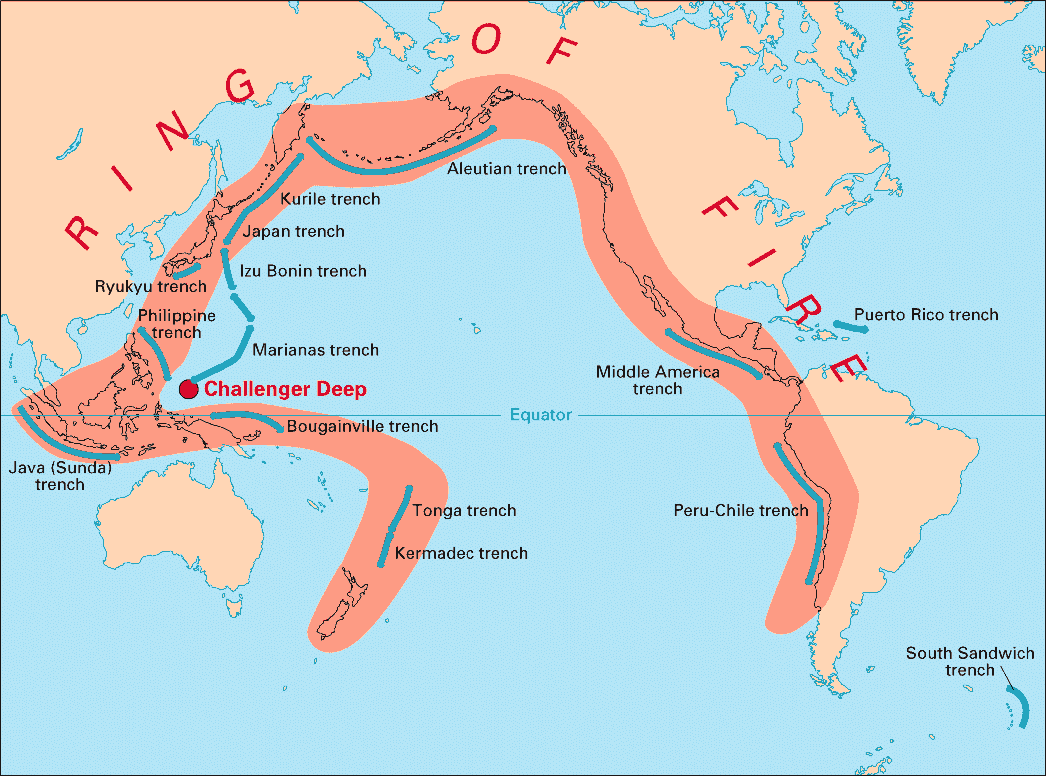
Our half-hearted discussions about updating our earthquake preparedness kits resurfaced these past few weeks, but I don't know anyone who is actually doing it. It may surprise those who live on firmer ground how matter-of-fact most of us in this region are about this Sword of Damocles looming over our heads. We trade in this brewing threat for our perfect Mediterranean climate, abundant natural wonders, and wonderful fresh food. We bask in all this glory as the Pacific Plate slides beneath the North American Plate under our feet.
Don't get me wrong, we aren't completely complacent. Our building codes aim to be vigilant about "The Next Big One". All brick buildings must be reinforced, our Bay Bridge is being rebuilt, and many of our favorite buildings were condemned to the wrecking ball after the 6.9-magnitude Loma Prieta Earthquake in 1989.
One of the buildings suffering devastating damage in the 1989 earthquake was the De Young Museum in San Francisco's Golden Gate Park. During the construction of the new building, the museum approached British sculptor Andy Goldsworthy to create an installation for the entry courtyard. Goldsworthy already completed the earthquake-related sculpture, Stone River, at nearby Stanford University. Formerly called "Faultline", now called "Drawn Stone", Goldsworthy drew inspiration from the seismic movement that ultimately brought the De Young's original 1895 building down.Visitors can now follow a tiny fissure in the stone pavers, beginning just outside the building, into the courtyard, where it builds momentum and rises in amplitude bisecting large cuboid boulders.

Appleton Greenmoore sandstone pavers

Many visitors pass without noticing the faultlines snaking through the courtyard. Its understated appearance belies the force required to form this work.


Goldsworthy painstakingly created this installation over the period of three months. Click here to view a great video of Goldsworthy in action.
While you do that, I think I'll review our earthquake-preparedness kit while Johnny Cash sings of a different "Ring of Fire" altogether:
Note: Many earthquake victims around the world still need aide. See the badge on my side bar to learn of one way to help.
Another note: Please forgive the blue-green cast of the last photo; I was shooting through the second floor window.
Monday, January 4, 2010
Macro Monday – Yosemite Reflections

California incense cedar (Calocedrus decurrens)
We reflected back to our last visit here when our son asked to come here for spring break:


We decided to visit the same places…

This time the water was still, allowing for more reflection:


The ultimate place for reflection in Yosemite is of course Mirror Lake:

The grandeur of this park is a reminder that we are but a tiny element of nature. Yet, when we slow down enough to look closely, we can find reflection in the smallest places like in the water drops on the California incense cedar. Click here to see a larger version.

See other Macro Monday photos hosted by Lisa, you won’t be disappointed.
Thursday, December 31, 2009
Happy New Year Yosemite Style

Yesterday my husband and I returned from our brief trip to Yosemite National Park. We felt so fortunate that a snow storm during our last night there produced a wondrous winter wonderland. This new layer of pristine snow seemed a fitting way to greet the New Year. Here’s a toast to a fresh start, a clean slate, a chance to break trail.


Thank you for visiting dutchbaby and for your comments, your friendship, and for publishing your blogs that nourish my soul throughout the year. I end 2009 with a beautiful Scottish rendition of Auld Lang Syne sent to me by one of my book club sisters.
Happy New Year to you all!
Monday, December 28, 2009
Macro Monday - Burl

This burl came from this tree...

...from a slice of paradise called Yosemite National Park.

My husband and I chose to go here for our honeymoon not just because it is one of our favorite places in the whole wide world, but because it is only about 150 miles from Palo Alto. We love going there to rejuvenate our spirits. We were there this spring, but now we return for a couple of days to celebrate our twentieth anniversary. I hope to bring back similar photos except with lots of snow.
Update:
Upon the advice of awarewriter, I made my first attempt at creating a black and white version of a photo:

Then I decided to give a go at tinting it:

Another Macro Monday hosted by Lisa.
Monday, December 14, 2009
Tech Awards 2009 – The Intel Environment Award Laureates

In my November 20th post I promised I would tell you about the Tech Awards Laureates. Travel and a very bad cold that kept my head in a fog prevented me from making good on my promise until now.
The Tech Awards were granted in five categories: environment, economic development, education, equality, and health. Each of the Tech Award Laureates received a beautiful trophy: a crystal globe on a silicon ingot and one winner in each category received a $50,000 cash award from the sponsors.
Today I will tell you about the winners of the Intel Environment Award.
Today I will tell you about the winners of the Intel Environment Award.
Cows to Kilowatts

The top award in this category went to Dr. Joseph Adelegan’s ingenious Cows to Kilowatts project in Nigeria. Adelegan deviced a means to transform slaughterhouse wastewater into energy ranging from electricity to cooking gas.

Not only does the project prevent air pollution and diseases borne by untreated wastewaters, the technology uses a zero-emissions method to produce organic fertilizer and clean-burning methane for low-income farmers and families.
LeafView: An Electronic Field Guide

Dr. Sean White enthusiastically demonstrated the LeafView gadget that can take a picture of any leaf and then automatically identify it by using computer vision algorithms and its extensive electronic field guide database. White developed the human-to-computer interface together with Columbia University, University of Maryland, and Smithsonian Institution.

Photo: Columbia University
The tool then records the leaf and its contextual data, like GPS coordinates, to the living record of the world’s plants. Botanists are in a hurry to populate this database because the world is loosing species faster than it can record them.

Photo: Columbia University
White hopes to recruit more volunteers so that he can complete development of the iPhone application. The ubiquitous availability of this tool can contribute to the world’s digital herbaria more accurately and exponentially faster than ever before.
GRUPEDSAC: Ecotechniques Toolkits for Self-Sufficiency

I had the great pleasure of meeting Lilly Wolfensberger who accepted the award for GRUPEDSAC, the organization in Mexico who dispenses eco-friendly toolkits to rural families who live below the poverty line. The toolkits include, cisterns for collecting rain water, prickly pear natural paint and waterproofing resin, a solar dehydrator, a solar water heater, a wood-saving stove, a wind/solar generator, a rope pump, an electricity-generator bicycle, and a solar oven. The recipients of these toolkits also receive training and guidance to ensure that the communities can become self-sufficient while preserving the environment.
I hope to tell you about the other laureates as soon as possible.
Monday, November 23, 2009
Macro Monday – Painted Reed Frog

Painted Reed Frog (Hyperolious marmoratus)
awarewriter inspired me to post the panned out version of this photo. The foreground reeds remind me of an ikebana arrangement:

Visit host Lisa at Macro Monday.
Subscribe to:
Posts (Atom)

