Showing posts with label nautical. Show all posts

Tuesday, January 25, 2011

Maelstrom in Saltstraumen

IMG_4460 Saltstraumen inflatable boats


Can you imagine what 13 billion cubic feet of water rushing through an impossibly narrow, 500-foot-wide channel would look like? I couldn’t fathom it, but I was about to find out.

During our family vacation on the Hurtigruten Cruise in Norway, we signed up for the “Saltstraumen Safari” near the city of Bodø. This excursion promised to take us to Saltstraumen, the sound that connects the Saltfjord on the west and the much larger Skjerstadfjord on the east. When the tide tries to fill the Skjerstadfjord, up to 400 million cubic meters of seawater surges through the strait that is only 3 kilometers long and 150 meters wide.

View Norway in a larger map (use buttons on top left to zoom in or out)

Our guide carefully checked to make sure we were all properly dressed in our fashion-forward waterproof gear and helped us into the inflatable rubber raft.

IMG_4466 Saltstraumen guide

To the passengers’ squealing delight, our boat driver opened up the engine full throttle as soon as we cleared the speed limit zone near the docks.

On the Norwegian Sea side of the buoys, the water was still quite calm...

IMG_4465 Saltstraumen buoys

...but minutes later, we saw that the rock formations along the banks of the fjord bore clues to their turbulent past.


IMG_4455 saltstraumen scenery

IMG_4454 Saltstraumen scenery

As the channel narrowed, the teal blue water became more restless.

IMG_4472 Saltstraumen blue water

Four times daily, the current can gain speeds up to 22 knots (~40 km/hr or ~25 mph), making this the strongest tidal current in the world.

IMG_4490 Saltstraumen current

The topography creates powerful whirlpools also called Maelstroms.


IMG_4487 Saltstraumen maelstrom

We passed through when the current was turning and the water was deemed "navigable". During the peak, the vortices of the whirlpools can reach 10 meters (~30 ft) in diameter and 5 meters (~15 ft) in depth. The force of these maelstroms are capable of eroding holes in the rock bed that are over 40 meters (~130 ft) deep.

We all gasped when our guide told us that extreme scuba diving is a popular sport here.


It seemed contradictory to see the bucolic scenery along the banks, with hikers enjoying the delicate wildflowers and sidestepping roosting waterfowl.

IMG_4498 Saltstraumen scenery

I was actively concerned for the safety of this black cow who looked like she could loose her footing on the slippery rocks at any moment.


IMG_4500 cow at Saltstraumen

We saw many fishing boats with motors fit enough to get them out of most any maelstrom jams.

IMG_4513 Saltstraumen fishing boat

I know nothing of fishing but it looks like this boat is equipped with every kind of fishing rod imaginable, or are they backup rods in case they loose a battle in the vortex?


IMG_4514 Saltstraumen fishermen

We even saw one angler catch a fish, but they deemed it too small and tossed it back into the maelstrom. Anglers most commonly catch saithe and cod, but they can also expect to catch catfish, rose fish, trout, herring and halibut. Coalfish is the specialty of this area.

BTW, if you look closely, you can see that this small boat is powered by a 400 horsepower engine (!).


IMG_4515 Saltstraumen fishermen

Then it was time to jet back because the tide was gaining strength.

IMG_4493 Saltstraumen inflatable boat

***

UPDATE: Thanks to Cuban in London, I have found the riveting short story by Edgar Allan Poe "A Descent into the Maelstrom" (1841). Here is an excerpt:

In a few minutes more, there came over the scene another radical alteration. The general surface grew somewhat more smooth, and the whirlpools, one by one, disappeared, while prodigious streaks of foam became apparent where none had been seen before. These streaks, at length, spreading out to a great distance, and entering into combination, took unto themselves the gyratory motion of the subsided vortices, and seemed to form the germ of another more vast. Suddenly --very suddenly --this assumed a distinct and definite existence, in a circle of more than half a mile in diameter. The edge of the whirl was represented by a broad belt of gleaming spray; but no particle of this slipped into the mouth of the terrific funnel, whose interior, as far as the eye could fathom it, was a smooth, shining, and jet-black wall of water, inclined to the horizon at an angle of some forty-five degrees, speeding dizzily round and round with a swaying and sweltering motion, and sending forth to the winds an appalling voice, half shriek, half roar, such as not even the mighty cataract of Niagara ever lifts up in its agony to Heaven.

The full story is here.
***

UPDATE: November 4, 2014.

One of the photos in this Flickr set was posted by tahoe_miner_174  on reddit, which inspired a spirited geological discussion here, It included a depiction, by mjackl, of the four major deformation events:


***

I will close with two videos. The first gives a brief look at the maelstrom in action.


This second video was taken by some brave divers.


Tuesday, September 21, 2010

The Viking Ship Museum - Gokstad ship


IMG_2603  Gokstad Viking Ship


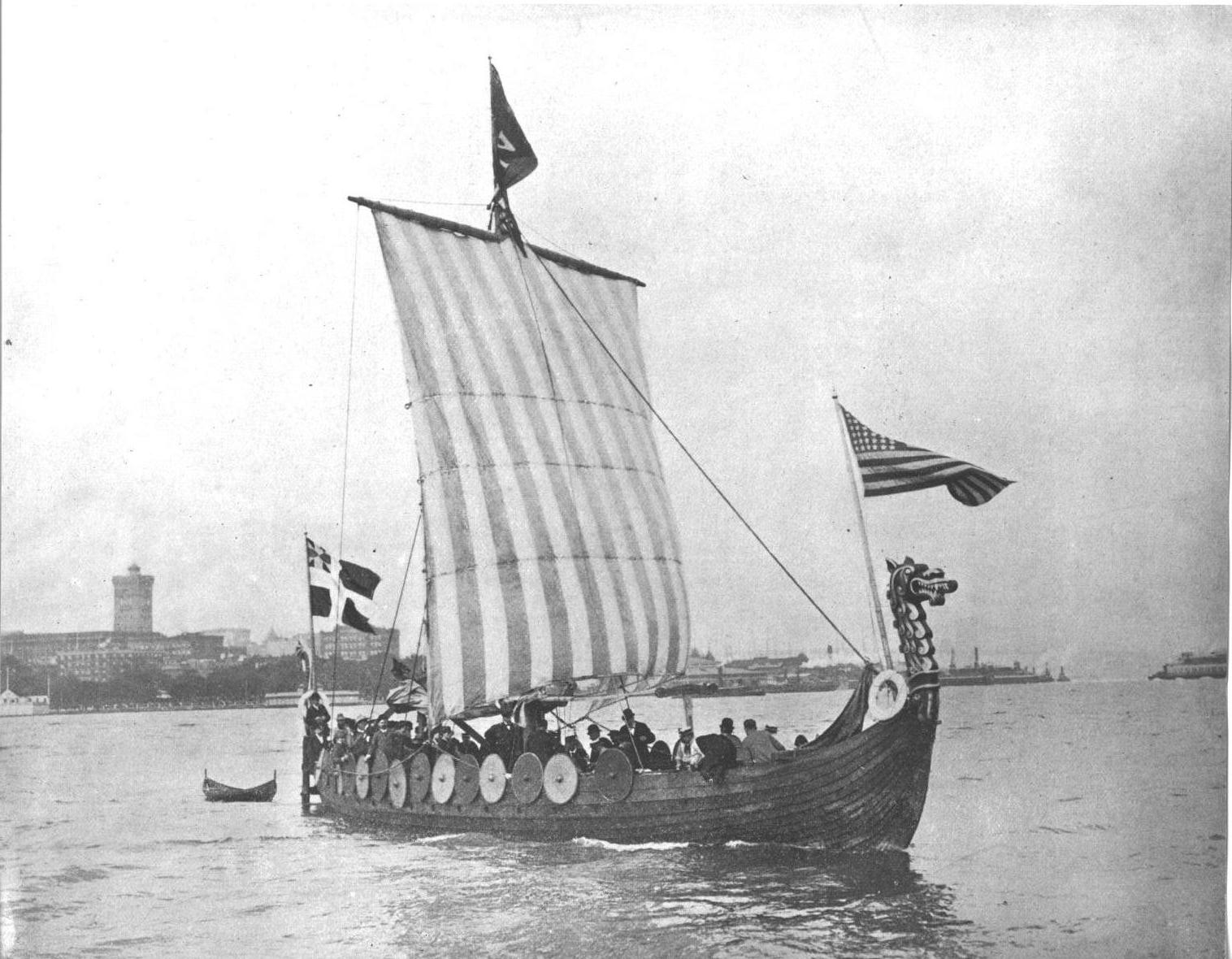
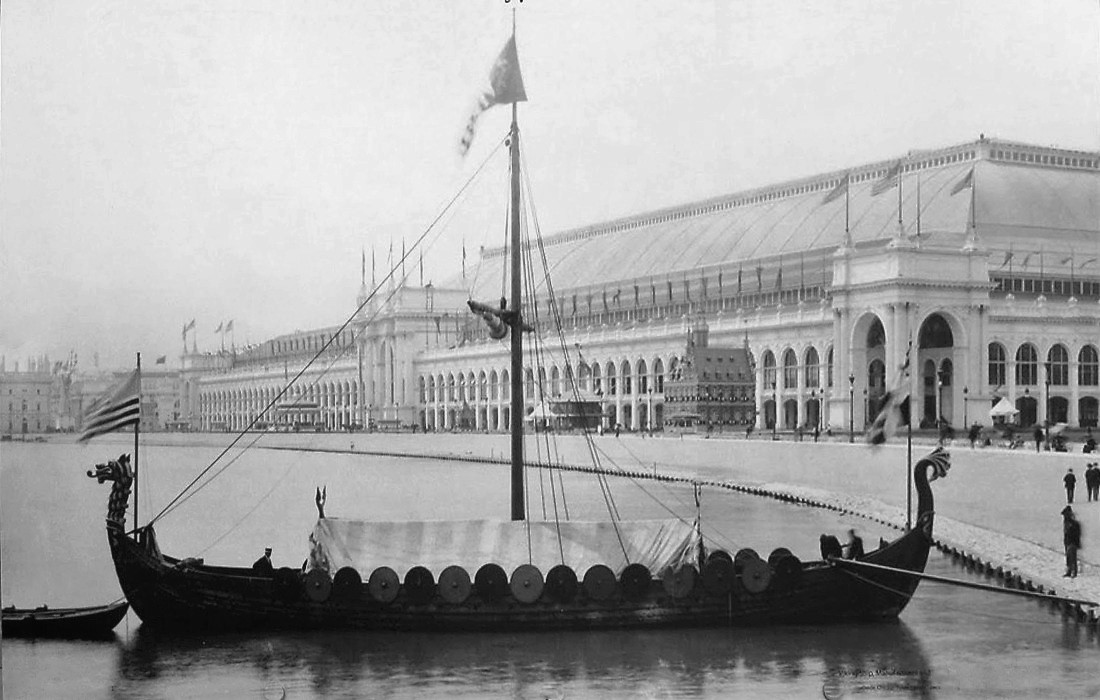
As beautiful as the ceremonial grandeur of the Oseberg was, the simple grace of the Gokstad was the ship at the Viking Ship Museum that took my breath away. Intuitively, this longship looked more seaworthy than the Oseberg. I later learned that in 1893 a full-scale replica of the Gokstad successfully completed a 44-day voyage across the Atlantic Ocean from Bergen, Norway to Chicago for the World’s Columbian Exposition. 

Image: http://www.danstopicals.com/gokstad.htm 

Ironically, the exposition was held in celebration of Christopher Columbus’ discovery of the western hemisphere in 1492. In a move that predated the term “political correctness”, in order to minimize offending the Columbian Exposition, the ship’s proposed name “Leif Ericson” was rejected in favor of “The Viking”.

Image: Wikipedia 


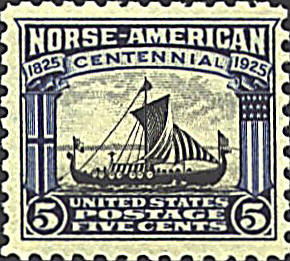
In 1925 a stamp commemorating the Norse-American centennial depicted the Gokstad’s replica, complete with the American flag at the bow and the Norwegian flag at the stern.

Image: danstopicals.com


* * *

Both the Oseberg and the Gokstad were built using the clinker method where the oak planks overlapped along the edges. The Gokstad is slightly bigger. 


Ship
Length
Width
Oseberg
21.58 meters (70.8 feet)
5.10 meters (16.7 feet)
Gokstad
23.24 meters (76.25 feet)
5.20 meters (17.1 feet)


IMG_2606  Gokstad Ship


A single piece of oak was used to ensure the structural integrity of the keel.The length of the keel then determined the dimensions of the rest of the ship. I imagine that the tallest and straightest oaks in the land would be a Viking boat builder’s greatest treasure.

IMG_2618 Gokstad Viking Ship


The invention of the keel is one of the key reasons for the Vikings maintained naval superiority for over two hundred and fifty years. A keel allowed the ship to be rowed and sailed as well. The smaller draught, along with a removable rudder, the ship had the distinct advantage of being able to navigate in shallow inland waters.

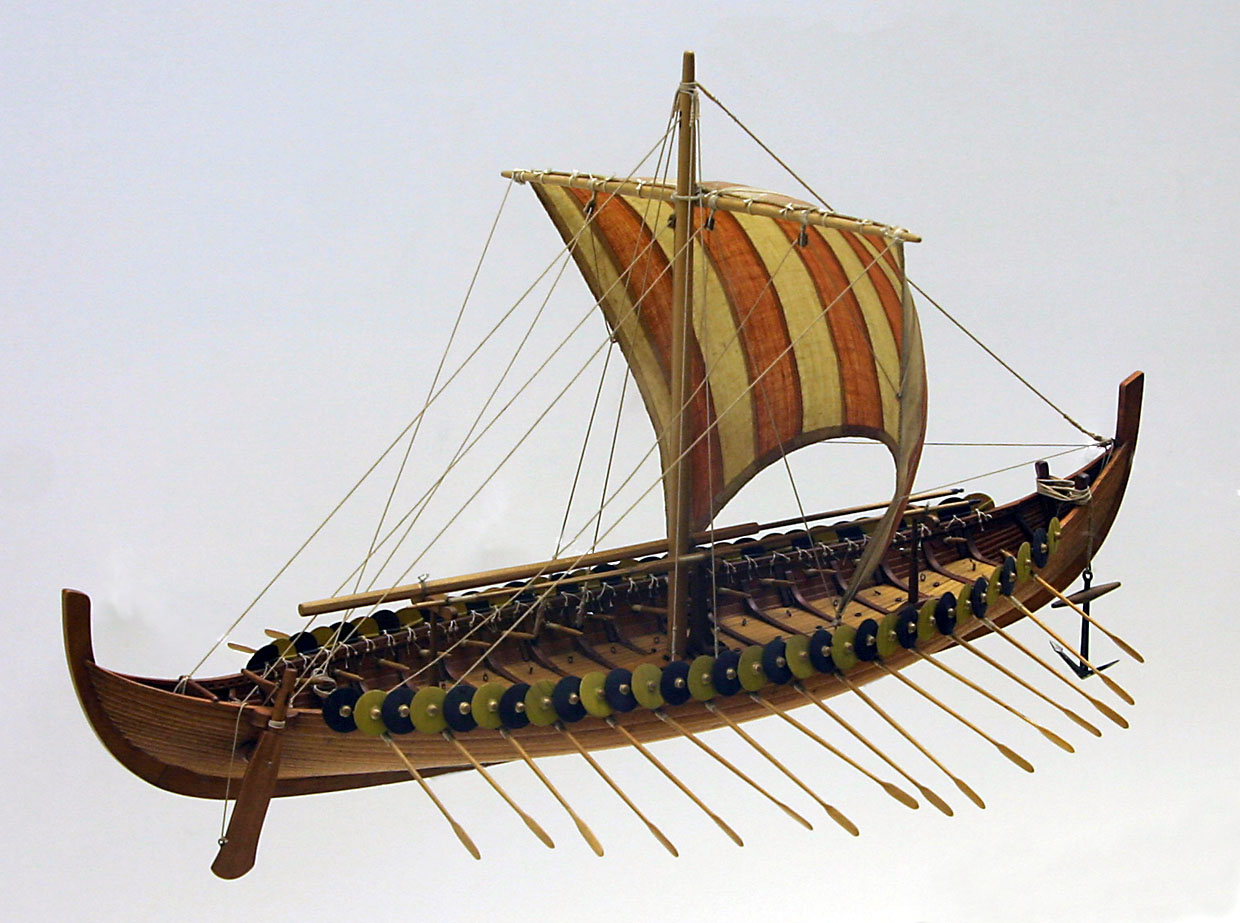
Remnants of 32 shields, alternately painted black and yellow, along with 16 oars for each side, and a striped woolen sailcloth were excavated from the buried ship. There were no benches, thus it is speculated that the oarsmen sat on their sea chests.


Model of the Gokstad ship
 Image: Wikipedia


Like the Oseberg, the Gokstad was used as a burial chamber. A 50- to 70-year-old male was uncovered with the ship along with some modest grave goods. It is believed that the valuable items were plundered long ago.


IMG_2607 Gokstad Viking Ship


The third ship at the Viking Ship Museum is a 22-meter fragment of the Tune ship.


IMG_2602 Tune Ship

The incomplete state of this ship reminds us how remarkable the nearly complete finds of the Oseberg and Gokstad were.

Wednesday, September 8, 2010

The Viking Ship Museum in Oslo - Oseberg Excavation

IMG_2585 Oseberg Viking Longship

During our stay in Oslo, we ferried over to Bygdøy peninsula where we spent the day visiting several impressive cultural and historical museums. The Oslo Pass proved to be a great investment because it was accepted on the public ferry to Bygdøy and at all the museums here.

The Viking Ship Museum was a great treat for my brother-in-law because, like his father did, he works on the San Francisco Bay every day. We say that he has salt water running through his veins, no doubt a trait that passed down from his Norwegian ancestors.

The Oseberg Viking Longship

The Oseberg Viking longship is the world’s most complete ship ever found. A farmer discovered the ship in 1903 while he was digging in a mound on his farm. The following summer, Swedish archeologist Gabriel Gustafson led an excavation team for five months until the last piece of the the 70-foot longship was unearthed. The blue clay of the mound preserved the wood for longer than a millenium.

Image: Univeristy of Oslo 

It was determined that the ship dates from before the year 800 and that she was buried since 834. Conservators spent twenty-one years meticulously restoring the ship using almost all of the original wood and even many of the original iron rivets. Unfortunately, the conservation method of boiling the oak in a concentrated solution of alum rendered the wood brittle as crisp bread. In 1926, the delicate ship was moved to her new, custom-made home where she still stands today.

Image: Univeristy of Oslo 
She is housed in the first room of the Viking Ship Museum which is bathed in a beautiful blend of natural and understated man-made lighting with a ceiling that is shaped like an upside down ship hull. As I was taking the photo at the top of this post, my son sidled up next to me and suggested that I take a couple of steps to the left. Then I saw what he saw...

IMG_2584 Oseberg Viking Longship

...a shadow twin.

IMG_2588 Oseberg Viking Longship with shadow twin

The frond-like prow ...

IMG_2590 Oseberg Viking Longship

.... turned out to be the head of a serpent...

IMG_2587 Oseberg Viking Longship

... with its body intricately carved along the keel and terminating with  its tail at the stern:

IMG_2592 Oseberg Viking Longship

A giant serpent emerging out of the fog would feed any fears and “confirm” numerous sightings of legendary sea monsters.

The Oseberg was thought to only be seaworthy enough for coastal voyages. A full-scale copy of the ship sank in the Mediterranean Sea during trials in 1987. The New Oseberg Ship Foundation hopes to make new replica.

The Oseberg's elaborate ornamentation suggests its use as a ritual vessel and, in fact, the ship was used as a burial chamber. When found, it contained the remains of two women with livestock and objects to be used for the afterlife. The opulence of the grave goods in the ship and the attire of the women suggested  that at least one of them was of very high status. They even unearthed the remains of a peacock which must have been an exotic pet.


The Oseberg Cart

The women were reburied in the original Oseburg mound, but many of the artifacts are on display in the museum. The extravagantly-carved Oseberg cart is the oldest known vessel with wheels in Norway.


IMG_2608 Viking Museum cart

It is believed that the artist who carved the decorations of the Oseberg ship also executed the carvings on the cart. The front of the cart depicts a pit of snakes...

IMG_2611 Viking Ship Museum cart

...surrounding a man believed to be Gunnar in the snake pit of Viking mythology. 

IMG_2614 Viking Museum cart detail

Gunnar was chained and thrown into a pit of snakes but played a harp with his toes so well that all but one snake were lulled to sleep. Tragically, the final adder killed him.
Related Posts Plugin for WordPress, Blogger...
Bookmark and Share