Showing posts with label Andy Goldsworthy (1956 - ). Show all posts

Saturday, March 6, 2010

The Ring of Fire

DSC03377 Andy Goldsworthy faultline

I live within the Ring of Fire, less than five miles from the San Andreas Fault. The Ring of Fire is a 40,000 kilometer horseshoe partly encircling the Pacific Basin. Its continuous oceanic trenches and volcanic arcs create 90% of the world's earthquakes. With four significant earthquakes, in Haiti, Chile, Japan, and Taiwan, since the beginning of the year, there is talk whether the Ring of Fire is hyper-agitated right now.
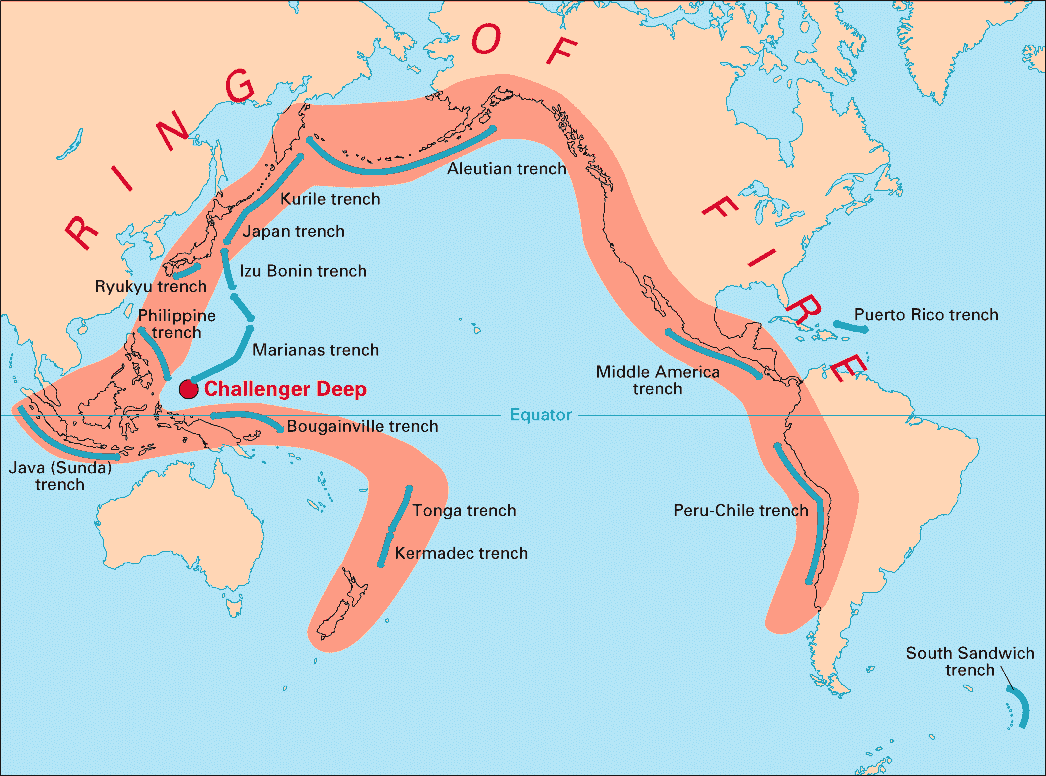

Our half-hearted discussions about updating our earthquake preparedness kits resurfaced these past few weeks, but I don't know anyone who is actually doing it. It may surprise those who live on firmer ground how matter-of-fact most of us in this region are about this Sword of Damocles looming over our heads. We trade in this brewing threat for our perfect Mediterranean climate, abundant natural wonders, and wonderful fresh food. We bask in all this glory as the Pacific Plate slides beneath the North American Plate under our feet.

Don't get me wrong, we aren't completely complacent. Our building codes aim to be vigilant about "The Next Big One". All brick buildings must be reinforced, our Bay Bridge is being rebuilt, and many of our favorite buildings were condemned to the wrecking ball after the 6.9-magnitude Loma Prieta Earthquake in 1989.

One of the buildings suffering devastating damage in the 1989 earthquake was the De Young Museum in San Francisco's Golden Gate Park. During the construction of the new building, the museum approached British sculptor Andy Goldsworthy to create an installation for the entry courtyard. Goldsworthy already completed the earthquake-related sculpture, Stone River, at nearby Stanford University. Formerly called "Faultline", now called "Drawn Stone", Goldsworthy drew inspiration from the seismic movement that ultimately brought the De Young's original 1895 building down.Visitors can now follow a tiny fissure in the stone pavers, beginning just outside the building, into the courtyard, where it builds momentum and rises in amplitude bisecting large cuboid boulders.

DSC03375 Andy Goldsworthy faultline
Appleton Greenmoore sandstone pavers

DSC03376 Andy Goldsworthy faultline

Many visitors pass without noticing the faultlines snaking through the courtyard. Its understated appearance belies the force required to form this work.

DSC03378 Andy Goldsworthy faultline


DSC03563 Andy Goldsworthy faultline

Goldsworthy painstakingly created this installation over the period of three months. Click here to view a great video of Goldsworthy in action.

While you do that, I think I'll review our earthquake-preparedness kit while Johnny Cash sings of a different "Ring of Fire" altogether:


Note: Many earthquake victims around the world still need aide. See the badge on my side bar to learn of one way to help.

Another note:  Please forgive the blue-green cast of the last photo; I was shooting through the second floor window.

Thursday, March 26, 2009

“Stone River” by Andy Goldsworthy


I’ve walked by it many times without realizing it was there because its ridge is level with the ground.


In summer, the sandstones are perfectly camouflaged into the color of the dry golden grass and dirt.


And then one day, when tangobaby and I had a conversation about the genius of Andy Goldsworthy’s art, she told me that one of his works was right here in my own back yard.  I’m talking about Andy Goldsworthy’s 2001 sculpture “Stone River” , a 320-foot-long sandstone sculpture set in a 3 ½ foot channel in front of Stanford University’s Cantor Center for Visual Arts.


Andy Goldsworthy is a British sculptor who uses elements of nature and shapes them into art that fits perfectly into its environment. All his works are beautifully documented in his books and his DVD "Rivers and Tides".

Some of his art is impermanent, meant to be melted by the sun or washed away by the waves of the sea or rush of a river. Other works, like “Stone River”, are permanent. He supervised eight experienced dry-stone wallers from Great Britain while they worked six days a week, eleven hours a day, for three-and-a-half weeks in August 2001. In the mean time, Goldsworthy himself created a temporary sculpture of grasses and leaves just a few yards away. He describes:
 "The ephemeral work is the soul of my art. That is the food. All these other things that I do -- the permanent pieces, the installations in museums -- are like breathing out.” [1]
All of his art echoes the shapes of nature.  This wall reminds me of a rattle snake I might see the in the hills not far from here, swishing back and forth in sinusoidal waves, as it propels itself through the dirt. It is hard to remember that this “creature” is made entirely of inorganic materials, yet it conveys so much life and movement.


Goldsworthy used sandstone from a repository of materials salvaged from Stanford University buildings damaged in the 1906 and 1989 earthquakes to create “Stone River”. The fact that he only uses found materials makes this “boneyard” the perfect source for this project.
"The idea of stone that was once a building returned to the ground, back into the earth, for a work that is about flow, movement and change, it was perfect. It was really perfect.”
His goal was to achieve “the ridiculous edge” as the spine of the wall.


His unflagging dedication to his work is legendary. He lamented that he had to interrupt his time with the sculpture in order to be guest of honor at the inauguration of the sculpture.
"I've stayed here watching it the whole day. I've seen incredible changes (now) there's a gap in my understanding of the piece… If you had to describe my work in one word, it would be 'time'."
I have to admit that I understand his frustration a tiny bit. The first photos I took of this sculpture were in July, 2007, when the sculpture looked arid and hot, like it had just risen up from the dirt, barely differentiating itself from its surroundings.


Then when I recently happened to drive by the location after a good rain storm, when the grass was bright green, the sculpture took on a completely different nature. It looked cool and lush, complementing its environment rather than melting into it.


I’m not sure if Goldsworthy has seen this piece in this blossoming state, but if he saw the dramatic changes, he would be want to be here year-round to get a fuller understanding of the piece. Hmm, that might not be all bad; maybe he’ll be inspired to do another work of art.

Flickr set here.
Related Posts Plugin for WordPress, Blogger...
Bookmark and Share