Showing posts with label art history. Show all posts

Monday, April 4, 2011

Macro Monday - Bouquets to Art 2011

DSC05664 Fleur de Vie - Market woman

As I mentioned in my previous posts about Bouquets to Art at the De Young Museum in San Francisco, this year's exhibition one of my favorites. One reason is that several floral artists have selected works of art that I don't recall being chosen before.

I have always adored this pair of small paintings by Thomas Waterman Wood and was delighted that Market Woman was tapped.

DSC05769 Market Woman


Fleur de Vie floral designer Talin Tascian created a spectacular floral twin using the king protea's petals for her shawl and its silver flower heads in her shopping basket. Her apron was composed of woven flax (hala) leaves and her skirt black ti leaves. 

DSC05666 Market Woman detail - Fleur de Vie

***
I have walked by this beautiful fireplace mantel countless times and never noticed that the legs were carved dogs, until Grace Street Floral  made it patently obvious.

DSC05667 Rhonda Stoffel

I imagine that Rhonda Stoffel had a blast choosing the materials for this whimsical sculpture. Rust hypericum berries (St. John's Wort), white tallow berries, and succulents were great choices for the face. I will never look at the under side of a magnolia leaf again without thinking that it looks just like the velvety ear of a dog. In fact, I believe I will be hounded by this image. 


DSC05668 Rhonda Stoffel

Update - Rhonda Stoffel wrote me and shared this:
Yes he WAS super fun to make — I’ve been wanting to do something with those crazy-amazing dogs for AGES and was excited to finally have the opportunity to do so ( as usually the person who chooses that piece highlights something with the TOP part of the mantel - with more of the deer motif) — The dogs finally got their proper 15 minutes of fame!
***
The initial inspiration for David Regan's Cod Tureen dates all the way back to biblical times in the Gospel of James where the metaphor of big fish eating little fish was used to illustrate the rich exploiting the poor*. In the mid-sixteenth century, Pieter Breugel the Elder depicted this story in a painting. Pieter van der Heyden, in turn, created the companion engraving in 1557. David Regan formed the ceramic version in 1997.

DSC05806 David Regan - Cod Tureen

Thierry Chantrel of La Follia created the most recent incarnation...

DSC05692 La Follia - cod tureen

...nearly 400 years after tulip mania and using the marine currency of sand dollars .

DSC05803 Thierry Chantrel - sand dollars

***

Though it is refreshing to see new works of art interpreted, it is still exciting to visit the perennial favorites. Some of you may recall the 2009 interpretation of James Bard's The Steamship Syracuse. This year, College of San Mateo's C. Diana Vigil and floristry students did an admirable job echoing the Mississippi steamboat with blue delphiniums, white roses, and phaleonopsis orchids.

DSC05773 College of San Mateo


In 2009, the window of Job Lots Cheap was the emphasis. This year, this trompe l'oeil was enhanced by Nancy Liu Chin's literary contribution:

DSC05690 Nancy Liu Chin - Job Lot Cheap

Sunshine Flowers and Event Design literally weighs the question: "Why compare apples and oranges?" on a vintage scale...

DSC05797 apples and oranges

... in response to William Rickarby Miller's Still Life -- Study of Apples, 1862 and William Joseph McCloskey's Oranges in Tissue Paper, ca. 1890.

DSC05799 apples and oranges cropped


I hope that Marisse Newell's fantastic interpretation of Winter Festival conjures up images from the distant past for you...

DSC05711 Marisse Newell - Winter's Festival

DSC05816 Marisse Newell - Winter's Festival

...and that instead, you are looking out your window to newly sprung blossoms, like these arranged by Ikebana International.

DSC05830 Ikebana International - Bay Area

Paradise Flowers' amaryllis blossoms are a great red-headed representation for Robert Henri's "The Lady in Black with Spanish Scarf", 1910.

DSC05712 Paradise Flowers - Lady in Black with Spanish Scarf


Emil Yanos thought out of the box when he complemented The Blue Veil with a striking abstract sculpture.

DSC05822 Emil Yanos - Blue Veil


See more Macro Monday images here and stay tuned for more stunning images from the 2011 Bouquets to Art in upcoming posts.
______
* Source: Wiki and The Met
Enhanced by Zemanta

Monday, November 22, 2010

Emulating Paul Cézanne


20101102_2429 emulating cezanne


Before I emulated Irving Penn, I tried to emulate Paul Cézanne for a photo assignment in my beginning photography class. I used Apples and Oranges as inspiration...


Paul Cézanne (1839 - 1906), Apples and Oranges

... but it was Still Life with Onions that inspired me to choose Cézanne.

Paul CÉZANNE, Still Life with Onions, 1896-1898

Paul Cézanne, Nature morte aux oignonsentre 1896 et 1898
huile sur toile, H. 66 cm; L.82 cm.

This generously-sized still life commanded my attention during a recent post-impressionist exhibit at the De Young Museum. I suddenly saw Paul Cézanne in a different light. This seemingly simple composition belies the complex use of geometry, colors, and negative space.  But it was much more than the mechanics of this painting that bowled me over. The painter himself expressed it best:
“For an impressionist to paint from nature is not to paint the subject, but to realize sensations”
-Paul Cézanne

Though I still have a lot to learn about lighting, I was reasonably happy with my first attempt. I used Still Life with Basket of Apples for my second try...

Paul Cézanne, Still Life with Basket of Apples
....but I thought is was considerably less successful.

IMG_7880 Emulating Cezanne

I used the wrong perspective, the lighting was all wrong, I didn't have the right sized basket for the apples which threw off the balance, (can you hear the violins?) .... I felt my still life was generally lifeless. Things improved a tad when I added more visual weight on the left side. The lighting was better, but I saw too late that the photo was not properly framed and cropping is strictly forbidden for this assignment.

IMG_7885 emulating cezanne

After a few more tries, I yielded to Master Cezanne's genius and switched to Irving Penn, which proved to be equally challenging. You can view my many attempts here. 

I appreciated this assignment; I learned a little, but was humbled plenty.

Saturday, November 13, 2010

Irving Penn (1917-2009), Portraits and Still Lifes

Irving Penn - Family with Mother Nursing Child
Family with Mother Nursing Child, Cusco, Peru

This is a continuation of my previous post about the gifted photographer, Irving Penn.

Portraiture

Irving Penn carried the same minimalistic technique he used in his fashion photos through his work in portraiture. Even when traveling in remote locations, he created makeshift studios to eliminate any visual elements that may detract from his sitters. His sitters ranged from anonymous tribesmen from the Andes to butchers in Paris...

Bouchers, Paris, 1950, © Estate of Irving Penn 

...or celebrities with household names.


Truman Capote, New York, 1948, Copyright, The Irving Penn Foundation

Penn went to great lengths to create an effective portrait. In his early portraits, he created a tight corner on his set to create an intimate space. For some subjects, the corner provided great comfort, for others it was stifling.

The Duchess of Windsor, New York, 1948
National Portrait Gallery, London © The Irving Penn Foundation


Spencer Tracy, New York, 1948

***

 In later portraits, Penn abandoned the corner, opting to capture the sitter closely, with almost no space devoted to background. Each portrait reveals the essence of the sitter, like Grace Kelly's effortless elegance...

Grace Kelly by Irving Penn, 1954
Grace Kelly, 1954
...Yves St. Laurent's shyness...

Yves St. Laurent, 1983

...and the ultimate minimalist portrait of Miles Davis.


Above all, he always showed great respect for his subjects:
"Sensitive people faced with the prospect of a camera portrait put on a face they think is one they would like to show the world. ...Very often what lies behind the facade is rare and more wonderful than the subject knows or dares to believe." —Irving Penn, 1975.

***

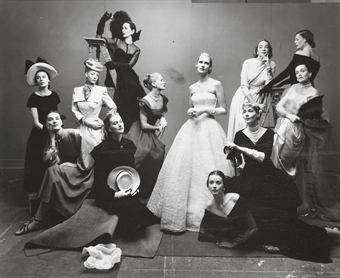
Penn's group portraits are always beautifully balanced with deliberate composition.

Top Models in 1947
They are still inspirational for contemporary photographers.

Steven Meisel, Vogue, May 2007


Still Lifes
Penn’s fascination with still lifes remained for all his life. Particularly fond of found objects, he famously said, “Photographing a cake can be art.” His still life images showcase his genius for composition and lighting.

Theater Accident
New York, 1947

After-dinner Games
New York, 1947

© Estate of Irving Penn   


Salad Ingredients
New York, 1947

© Estate of Irving Penn 


Later in his life Penn published a book of where he shared his love for flowers


Irving Penn - Poppy from his book Flowers

even when they were past their prime:


In 1977 he exhibited still lifes composed of street findings, including flattened trash retrieved out of the gutter. No doubt a response to his immersion in an industry that idolized youth and beauty for beauty’s sake.

Street Findings
New York, 1999

© Estate of Irving Penn 
All of Penn’s work showcases his genius for composition, lighting, and technique and his commitment to photographic fidelity is evident throughout his body of work.


Works Cited
"Quiet Passing Vogue, October 1, 1943. – Blue Filter." Blue Filter. Web. 19 Oct. 2010. . 
"Irving Penn, A Career in Photography." Traditional Fine Arts Organization. Web. 19 Oct. 2010. . 
"IRVING PENN (B. 1917) | Black and White Vogue Cover, 1950 | Photographs Auction | 1950s, Photographs | Christie's." Christie's - Fine Art Auctions | Contemporary Modern Paintings | Jewelry Auction House | Antique Furniture. Web. 19 Oct. 2010. . 
"Irving Penn." Photography Workshops and Photo Seminars On-line. Web. 19 Oct. 2010. . 
"Irving Penn." Wikipedia, the Free Encyclopedia. Web. 19 Oct. 2010. . 
Penn, Irving, Alexandra Arrowsmith, Nicola Majocchi, and Nicholas Callaway. Passage: a Work Record. New York: Knopf, 1991. Print.

Wednesday, November 10, 2010

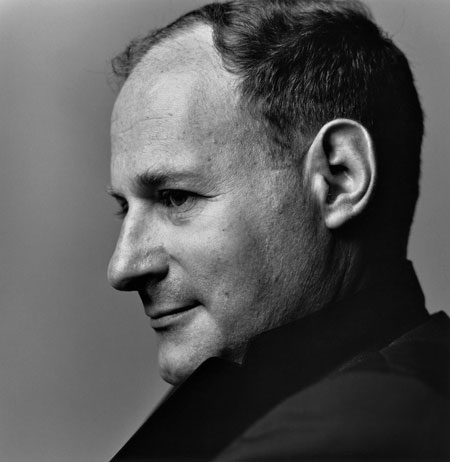
Irving Penn (1917-2009)

Jean Patchett
I thought I would share a research paper I wrote for my beginning photography class. I've always admired Irving Penn's photography; it was a joy to learn more about this gentle, creative artist.

Irving Penn, Photograph by Bert Stern/Associated Press
Early Life
Irving Penn was born in Plainfield, New Jersey in 1917 and received a degree in advertising design from the Philadelphia Museum School of Industrial Art in 1938. He began his career as an art director for Junior League magazine and later for Saks Fifth Avenue. In 1942 quit his job to pursue painting. After one year in Mexico, he abandoned the effort, concluding he would never be more than a mediocre painter.

Fashion
Upon his return, he was offered to be the stylist for the cover of October 1, 1943 issue of Vogue magazine. He created a still life, featuring an enormous topaz, and was then asked to also photograph the scene. It was Vogue Magazine’s first color cover.

Vogue Magazine’s First Color Cover
October 1, 1943
Thus began his long illustrious photographic career and his fifty-year association with Vogue magazine, where he completed 160 cover assignments.

Vogue 1946 Summer cover

Lisa Fonssagrives

Lisa Fonssagrives, Vogue UK, January 1950


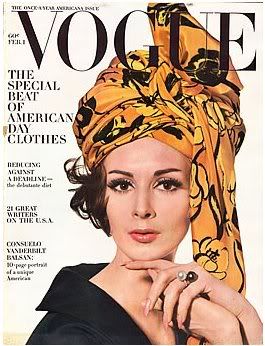
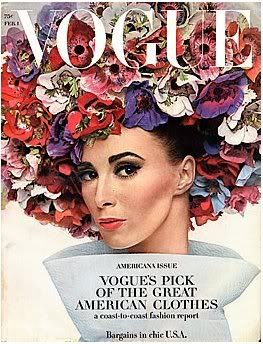
Wilhelmina Cooper, American Vogue  February 1st,1963..
Image credit

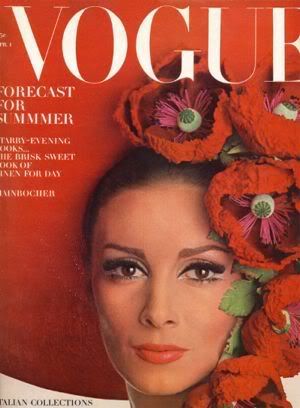
Wilhelmina Cooper, American Vogue February 1st,1964.
Credit:PaperPursuits.


Wilhelmina Cooper, American Vogue April 1st 1965.
Image credit
May 2004 Vogue featuring Nicole Kidman in Christian Lacroix

Click to view large
In 1950, Penn married his favorite model, Lisa Fonssagrives, who was credited with being the first supermodel.

Balenciaga Mantle Coat (Lisa Fonssagrives-Penn)
Paris, 1950 

Lisa Fonssagrives


Lisa Fonssagrives

Penn revolutionized fashion photography. He was a pioneer in creating a clean, simple fashion photographs emphasizing line and silhouette. He favored the studio setting and stripped away all props creating a minimalist look using only simple planes of neutral color as a backdrop. As a testament to his formal training in advertising design, he never forgot that the fashion products must be the star of his photos. Removing all irrelevant objects served to achieve this goal.

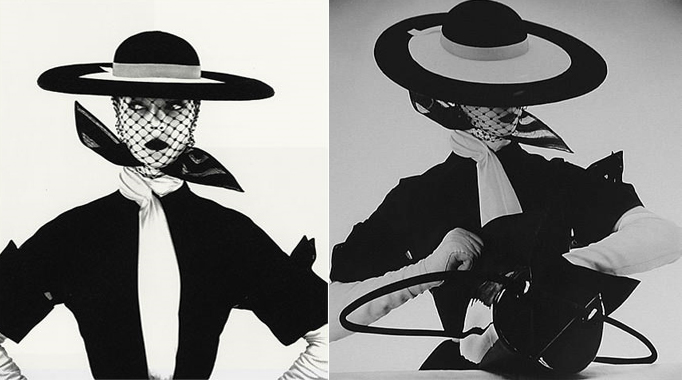
The photo used for the April 1, 1950 cover of Vogue, named “The Black and White Idea”, sold for $481,000 at Christie’s Auction House in 1985.

Jean Patchett, April 1, 1950 Vogue Magazine

The photo shows model Jean Patchett from the waist up wearing a black and white ensemble. Penn styled the shot with perfect balance, symmetry and obsessive precision. The backdrop is stark white, giving the greatest contrast possible for the mostly-black silhouette. Each fashion detail is highlighted: the wide-brimmed felt hat, the black neck scarf, and the short sleeves with split cuffs contrast to strike a precise silhouette against the white backdrop. The bird-cage netting and Patchett’s deep red lipstick, which reads black in black & white photos, contrast with her light complexion. Her eyes, looking to her extreme right, reveal the maximum whites, lest they get lost behind the netting. The elbow-length gloves were cropped away for the cover, creating an even stronger contrast. Given how the masthead and text of the cover fits comfortably in the white space without ever detracting from the photo, I’m guessing that Penn retained control over final layout. The overall result is a striking magazine cover that is arresting even if viewed from across the street. I have no doubt the cover generated countless inquiries about each piece of this ensemble.

Next time, Irving Penn's portraiture and still lifes. 
Related Posts Plugin for WordPress, Blogger...
Bookmark and Share