|
| Galápagos sea lion (Zalophus wollebaeki) |
After four days in Quito, we flew to the Galápagos Islands for a week-long adventure on the Eclipse. Each night after dinner, the passengers gathered in the lounge where one of the naturalists on board briefed us on our excursion options for the next day, followed by an informative talk about the islands. On our first night, Naturalist Javier Cando explained ecological terms to describe how native a species is.
Endemic: The organism is unique to one geographic location and nowhere else in the world. An endemic species may have originated here, or evolved into a separate species, or subspecies, due to geographic isolation.
Indigenous (native): The organism occurs in the location naturally, without the aid of humans. These species are carried to the region by wind, water, or by another organism.
Migrant: The animal travelled long distances in search of a new habitat.
Introduced: The organism is either deliberately or accidentally brought to a new ecosystem by human activity.
We all laughed when Javier told us that he was endemic to the Galapagos Islands. I guess I can say that my sisters and I were introduced into the United States by our parents, who migrated here.
***
I was a bit timid about using the camera my brother-in-law loaned me for this trip. Even though it was a point-and-shoot, it was the fanciest camera I had ever used. It was during this afternoon on July 29th, 2007, that marked the beginning of my love affair with the camera, and for that, I owe a great debt to my brother-in-law.
***
For our first excursion, the Eclipse cruised to Las Bachas Beach , on the north end of Santa Cruz Island. As we came close to shore, we watched a flock Frigatebirds dive for supper.
 |
| Frigate Birds (Fregata) |
I don’t know if they were the endemic Magnificent Frigatebird (Fregata magnificence) or the smaller, native Great Frigatebird (Fregata minor)...
 |
| Frigate Bird (Fregata) |
…but I do know that both species of Frigatebirds are kleptoparasitic. These rogues love to mob flocks of Blue-footed Boobies and force them to regurgitate so that their catch can be intercepted.
 |
| Frigate Birds (Fregata) and Blue-footed Booby (Sula nebouxii) |
I was excited to explore the mossy boulders to see what I could discover. Javier told us to stay away from the moss, not only because it’s slippery, but because we are not to disturb any of the fauna or flora. Careful not to tread on any moss, I did manage to photograph this American Oystercatcher, endemic subspecies galapagensis. This uncommon resident has only around 200 pairs in the Galápagos Islands.
 |
| American Oystercatcher (Haematopus palliatus galapagensis) |
 |
| American Oystercatcher (Haematopus palliatus galapagensis) |
A Yellow Warbler hopped between the rocks picking insects off the moss.
 |
| Yellow Warbler (Dendroica petechial aureola) |
Its race, aureola, is near-endemic and also known as the Mangrove Warbler.
 |
| Yellow Warbler (Dendroica petechial aureola) |
Looking across the rocky shore, I occasionally saw orange dots scampering about.

The Sally Lightfoot Crab is the most common crab along the west coast of the Americas and native to the Galápagos Islands.
 |
| Sally Lightfoot Crab (Grapsus grapsus) |
John Steinbeck‘s entertaining observations about how the Sally Lightfoot Crab lives up to its name can be read here.
 |
| Sally Lightfoot Crab (Grapsus grapsus) |
 |
| Sally Lightfoot Crab (Grapsus grapsus) |
We saw a solitary Galápagos Flamingo feeding on the far end of a saltwater lagoon when we joined Javier for brief walk. It is believed that the flamingo migrated from the Carribean and then evolved into an endemic subspecies here.
A Galápagos Mockingbird hopped around our small group, flitting back and forth between the sandy beach…
 |
| Galápagos Flamingo (Phoenicopterus ruber glyphorhynchus) |
A Galápagos Mockingbird hopped around our small group, flitting back and forth between the sandy beach…
 |
| Galápagos mockingbird (Mimus parvulus) |
…and the mangrove trees.
 |
| Galápagos mockingbird (Mimus parvulus) |
***

“I have specimens from four of the larger islands…The specimens from Chatham and Albemarle Isd. appear to be the same; but the other two are different. In each Isld. each kind is exclusively found. “
 |
| Floreana Mockingbird or Charles Mockingbird (Mimus trifasciatus) |
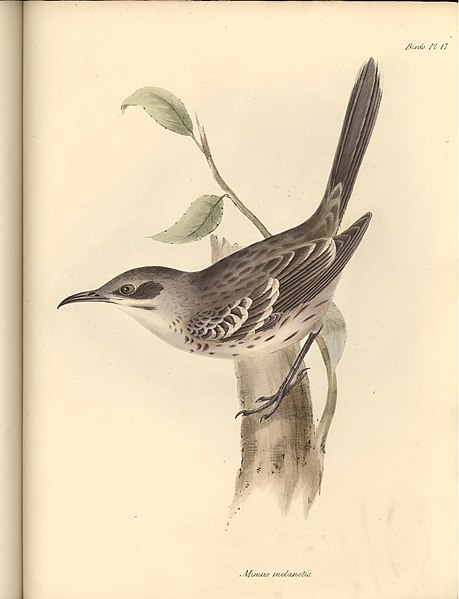 |
| San Cristobal Mockingbird or Chatham Mockingbird (Mimus melanotis) |
When Darwin returned to England, he used his mockingbird observation as the basis for concluding that the thirteen finches he observed in the Galápagos Islands all evolved separately due to the isolation of the islands.
***
 |
| Marine Iguana (Amblyrhynchus cristatus) |
“The black Lava rocks on the beach are frequented by large (2-3 ft), disgusting clumsy Lizards. They are as black as the porous rocks over which they crawl & seek their prey from the Sea. I call them 'imps of darkness'. They assuredly well become the land they inhabit.”I have to agree with my son; what's not to love about this remarkable creature?
 |
| Marine Iguana (Amblyrhynchus cristatus) |
 |
| Marine Iguana (Amblyrhynchus cristatus) |
Once he saw them on land, my son's next goal to was to see them swim in the ocean. They swam gracefully, swishing their tails in smooth back and forth waves.
 |
| Marine Iguana (Amblyrhynchus cristatus) |
As an extra bonus, we saw a green turtle swimming nearby.
 |
| Galápagos green turtle (Chelonia mydas agassisi) |
 |
| Galápagos green turtle (Chelonia mydas agassisi) |
The Galápagos green turtle is a subspecies of the green sea turtle we see in Hawaii. The species is indigenous, but the subspecies is endemic to the Galápagos Islands .
The same holds true for the Brown Pelican, with the amusing subspecies name urinator.
 |
| Brown Pelican (Pelecanus occidentalis urinator) |
 |
| Brown Pelican (Pelecanus occidentalis urinator) |
When we returned to the beach, we sat among the Galápagos sea lions.
 |
| Galápagos sea lion (Zalophus wollebaeki) |
 |
| Galápagos sea lion (Zalophus wollebaeki) |
…and all cooed when we saw the baby sea lions nursing.
 |
| Galápagos sea lion (Zalophus wollebaeki) |
This small beach was a great choice for our first excursion because it provided an intimate setting where the 47 passengers of the Eclipse had a chance to become acquainted with each other.
 |
| Galápagos sea lion (Zalophus wollebaeki) and Homo Sapien |
***
Works Cited
"File:Mimus Melanotis.jpg." Wikipedia, the Free Encyclopedia. Web. 12 Dec. 2011. <http://en.wikipedia.org/wiki/File:Mimus_melanotis.jpg>.
"File:Mimus Trifasciatus.jpg." Wikipedia, the Free Encyclopedia. Web. 12 Dec. 2011. <http://en.wikipedia.org/wiki/File:Mimus_trifasciatus.jpg>.
"Grapsus Grapsus." Wikipedia, the Free Encyclopedia. Web. 12 Dec. 2011. <http://en.wikipedia.org/wiki/Grapsus_grapsus>.
"INaturalist.org · Galápagos, EC." INaturalist.org · A Community for Naturalists. Web. 12 Dec. 2011. <http://www.inaturalist.org/places/12990>.
"Marine Iguana." Wikipedia, the Free Encyclopedia. Web. 12 Dec. 2011. <http://en.wikipedia.org/wiki/Marine_Iguana>.
Stewart, Paul. Galapagos: the Islands That Changed the World. New Haven, Connecticut, CT: Yale UP, 2007. Print.
Swash, Andy, Rob Still, and Ian Lewington. Birds, Mammals, and Reptiles of the Galápagos Islands: an Identification Guide. New Haven: Yale UP, 2005. Print.