Showing posts with label explorers. Show all posts

Thursday, January 13, 2011

The North Cape in the Land of the Midnight Sun


IMG_4899 Nordkapp


After our brief stop at the Sami trading post, we re-boarded the bus to reach the famous headland on the island of Magerøya named the North Cape of Norway.

English Explorer  Richard Chancellor named this point in 1553 when he passed the cape during his search for the Northeast Passage. Nordkapp is the Norwegianized form of the English name.

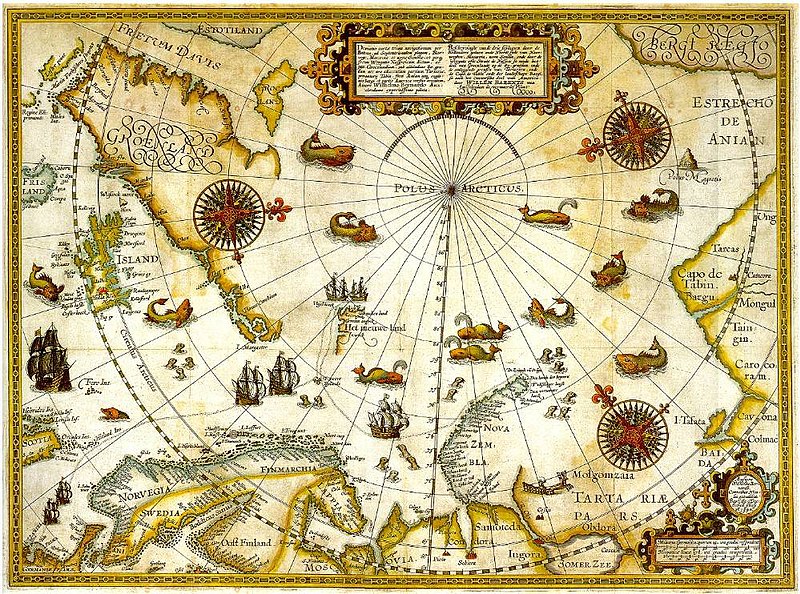
The North Cape is the point where the Norwegian Sea, the Atlantic Ocean, the Arctic Ocean, and the Barents Sea all converge. The Barents Sea was named after Dutch explorer and cartographer Willem Barentsz. This enchanting depiction is from the journal of fellow cartographer Jan Huyghens van Linschoten who joined Barentsz during his first two attempts at finding the Northeast Passage in 1594.
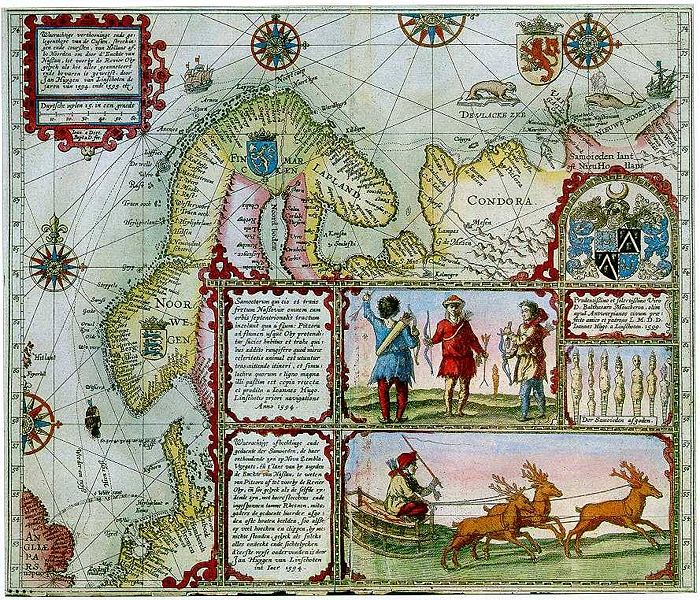
Source: Wikipedia
When I was in elementary school in Amsterdam, I learned about Barentsz’s tragic death at sea. I even had a jigsaw puzzle illustrating his quest. A nice summary of Barentsz's adventures can be found here at the website with the very intelligent name godutch.com. 

Barentsz remarkable map of his third attempt in 1597; it was published two years later. 


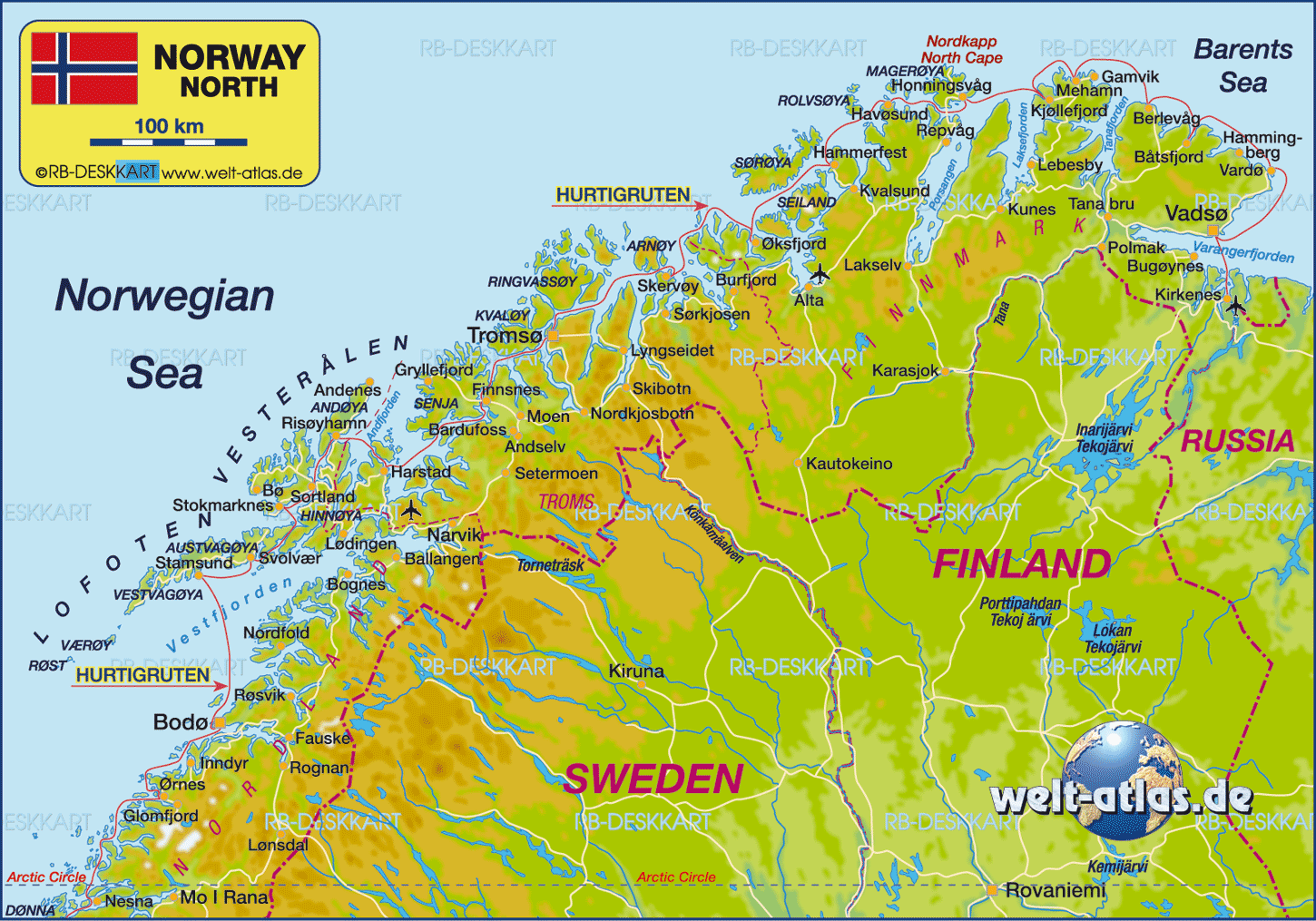
This modern, less fanciful, map shows the red Hurtigruten route we sailed on the “MS Midnatsol”. The North Cape is labeled, also in red, at the top of this map.

The North Cape is at latitude 71 degree, 10 minutes, and 21 seconds, just over a couple of thousand kilometers south of the North Pole. To give a frame of reference,  San Francisco is at latitude 38 north and London is at 51.
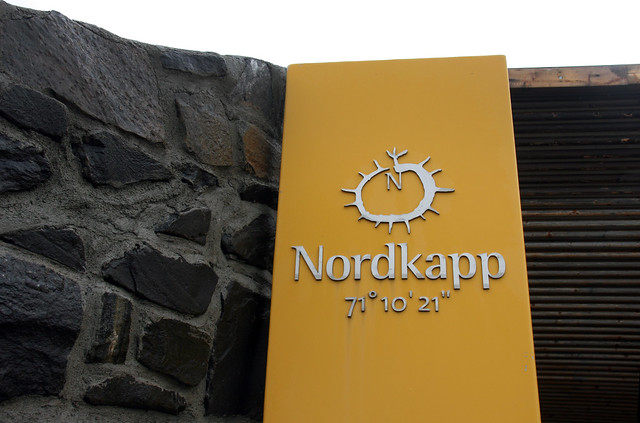

IMG_4878 Nordkapp 71 degrees 10 minutes 21 seconds

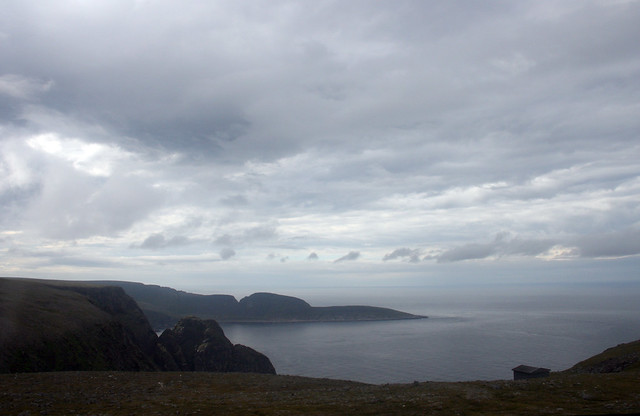
The North Cape's headland overlooks a barren, yet picturesque landscape. On this grey day, it was difficult to differentiate between the sky and the horizon.

IMG_4921 North Cape

The steep cliff rises 307 meters ( 1,007 feet) above the sea...

IMG_4891 Nordkapp

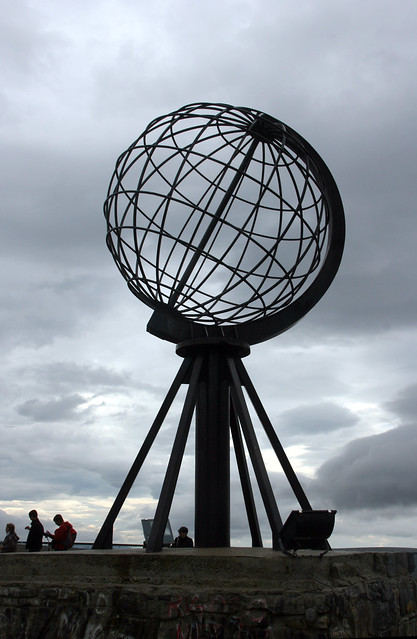
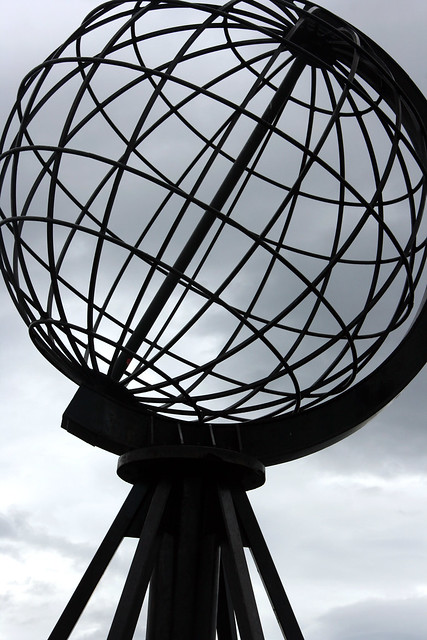
Today’s most iconic image of the North Cape is the globe that was built in 1978.
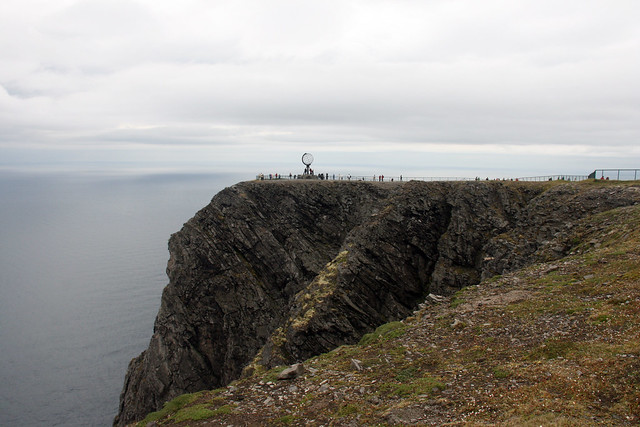
IMG_4915 Nordkapp


IMG_4898 Nordkapp

Daring explorers have scaled the walls of cliffs of the North Cape over the years. This spire commemorates the visit of King Oscar II of Sweden and Norway in 1873. 
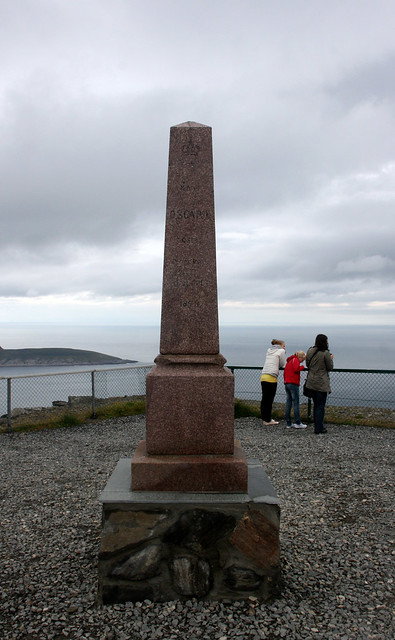
IMG_4910 North Cape King Oscar II spire


In 1956, a road was built to give easier access to this famous landmark. The North Cape Hall houses the elaborate tourist center...
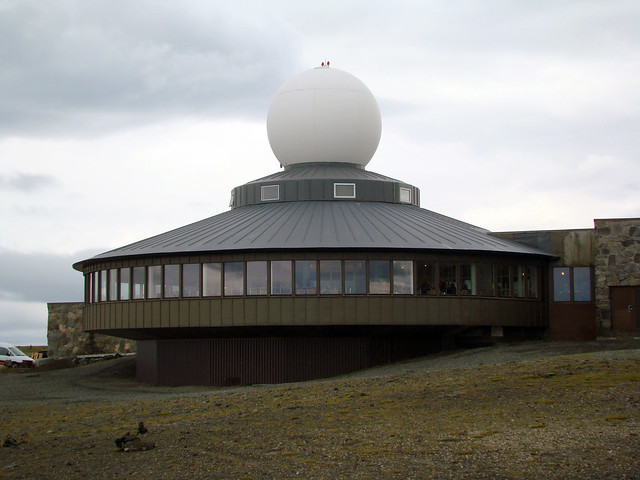
DSC07828 Nordkapp

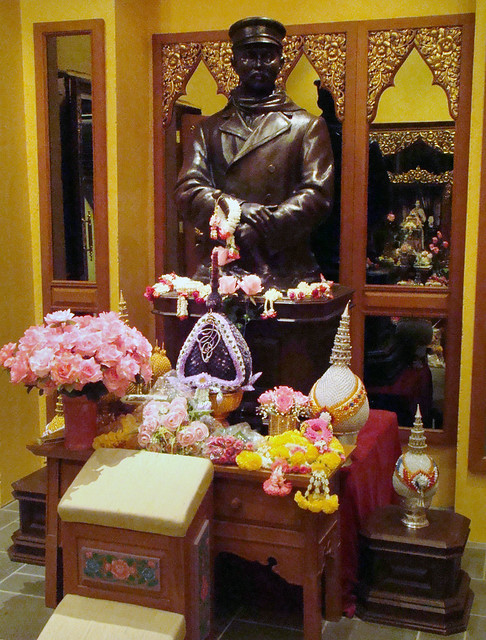
...which features full-scale dioramas of scenes of the journey and arrival of King Oscar II.  A Thai temple and shrine honor Thailand's King Chulalongkorn's visit in 1907.
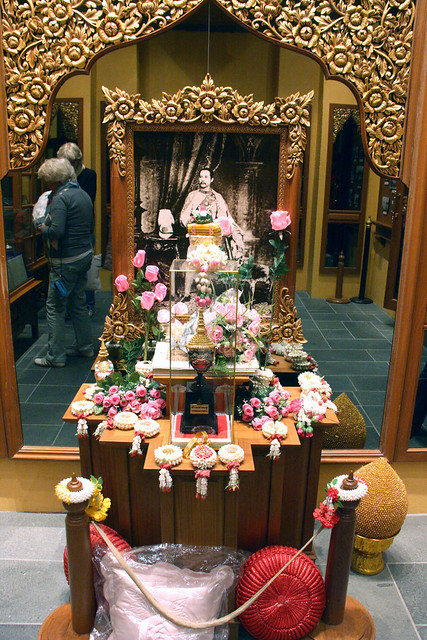
IMG_4886 nordkapp shrine thai kingDSC07835 Nordkapp shrine

The ecumenical chapel  St. Johannes Kapell...
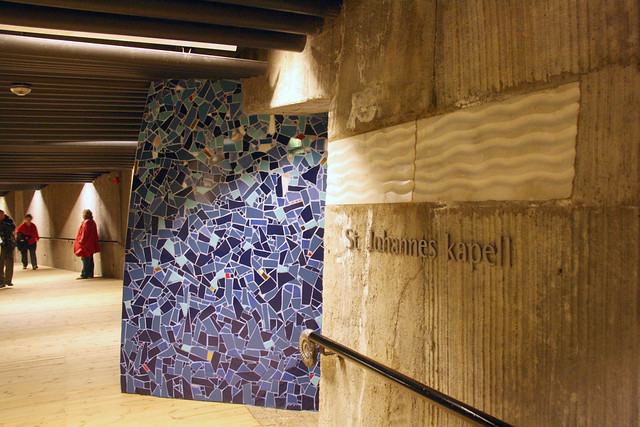
IMG_4888 st johannes kapell

...has a beautiful mosaic entry shaped like the bow of a ship.
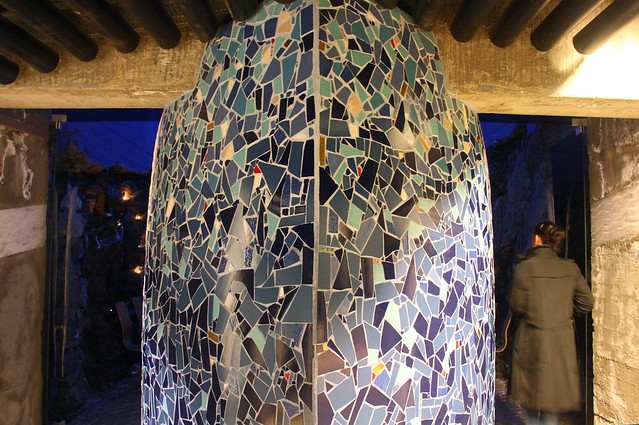
IMG_4887 nordkapp kappel ship's bow mosaic

...which is an altar with an opalescent mosaic on the inside.
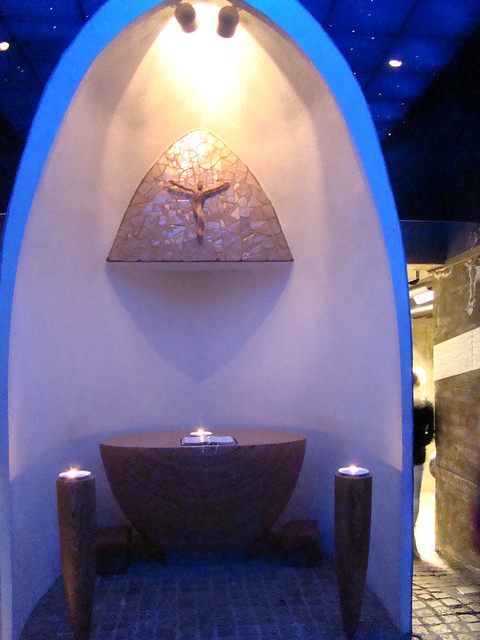
DSC07834 Nordkapp Chapel altar

A full bar, with its unique architecture and furniture that blends into the environment, allows you to take in the view while sheltered from the elements. 
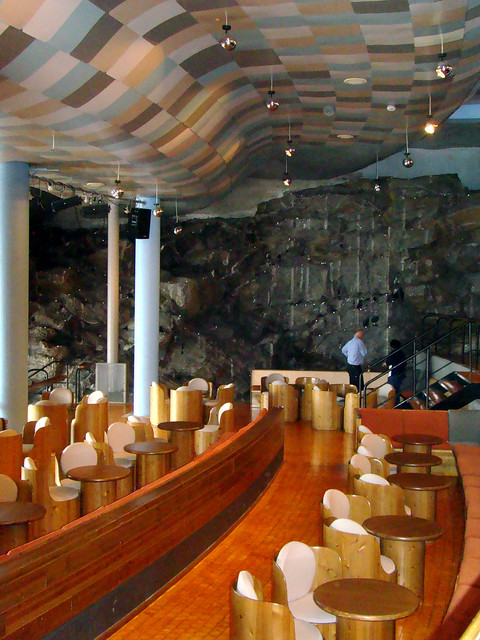
DSC07836 Nordkapp restaurant ceiling

We had soup and an open-face sandwich in the nautically-decorated cafeteria.
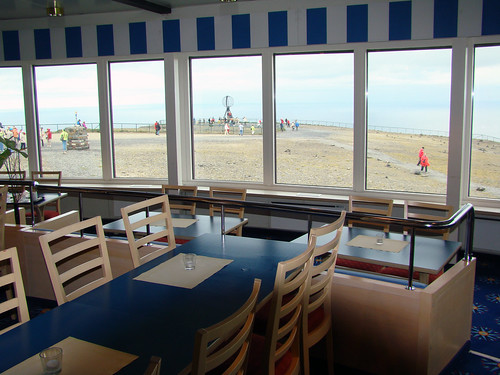
DSC07831 Nordkapp from cafe

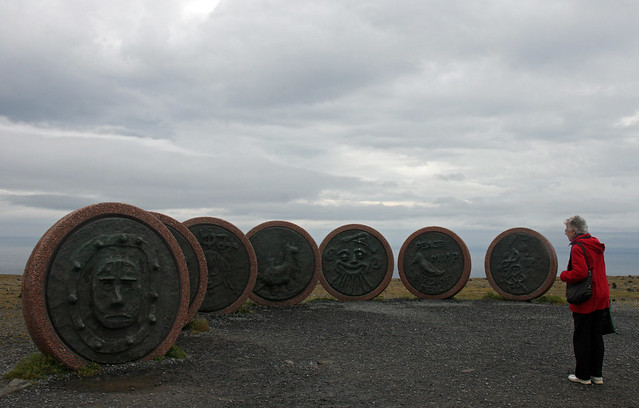
We had time to briefly visit the Children of the Earth Monument...

IMG_4903 North Cape Children of the Earth monument


...before our bus ride back to our ship.
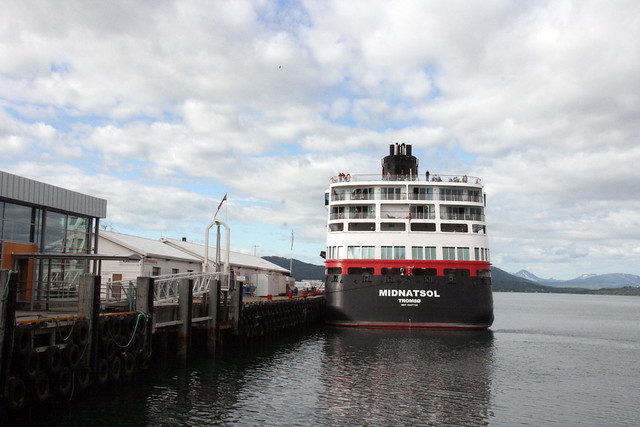
IMG_4588 Midnatsol


“Midnatsol” is the word for “midnight sun” in Norwegian. The midnight sun can be seen from the North Cape between May 14 and July 29. We were at the Cape on August 2nd, so technically the sun did set, but I certainly did not witness it. I remember waking up in the middle of the night curiously looking out our porthole. Though this was taken a few hours earlier, it looked very similar at three in the morning. 
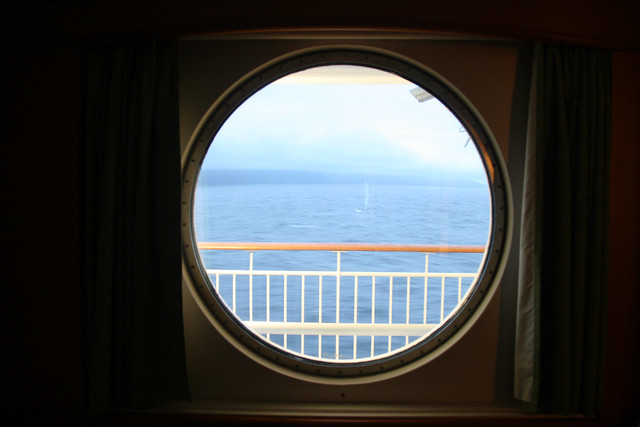

IMG_4946 Midnatsol porthole

I took this picture from the ships deck the night before, when we were still at the 70th parallel north.
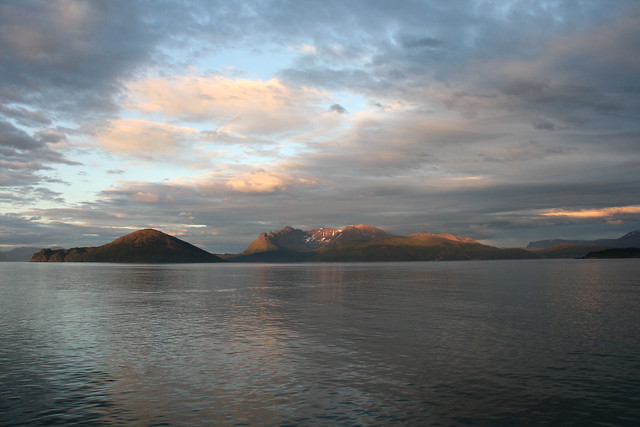
IMG_4739 from the Midnatsol

After seeing the beauty of the sun’s light in this part of the world, I can understand why the midnight sun has been a major inspiration for literature, music, and countless paintings.
Enhanced by Zemanta

Tuesday, September 21, 2010

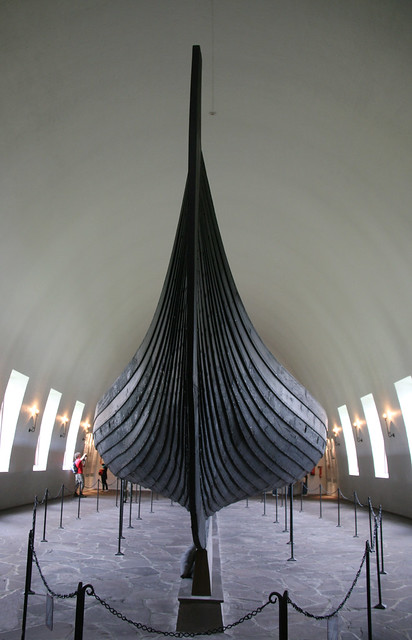
The Viking Ship Museum - Gokstad ship


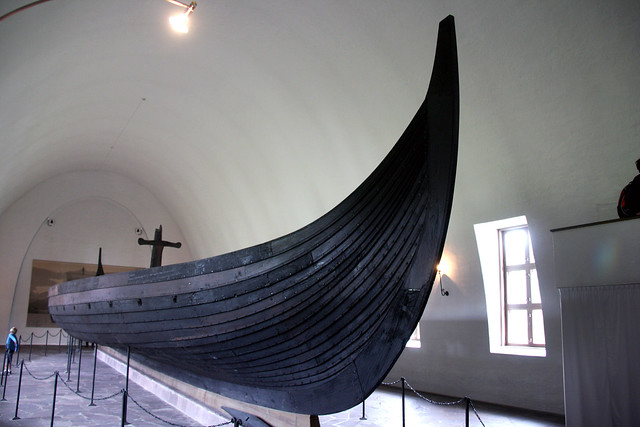
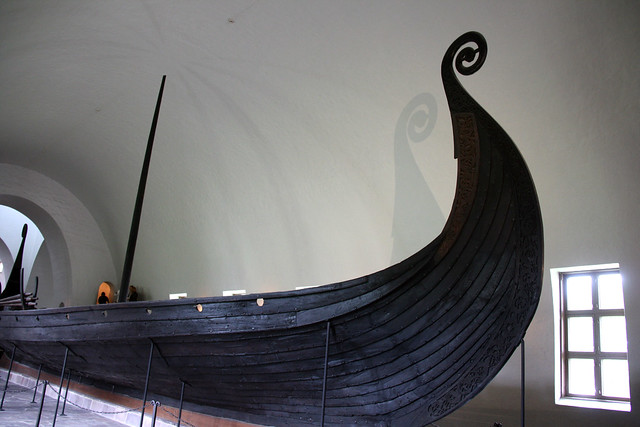
IMG_2603  Gokstad Viking Ship


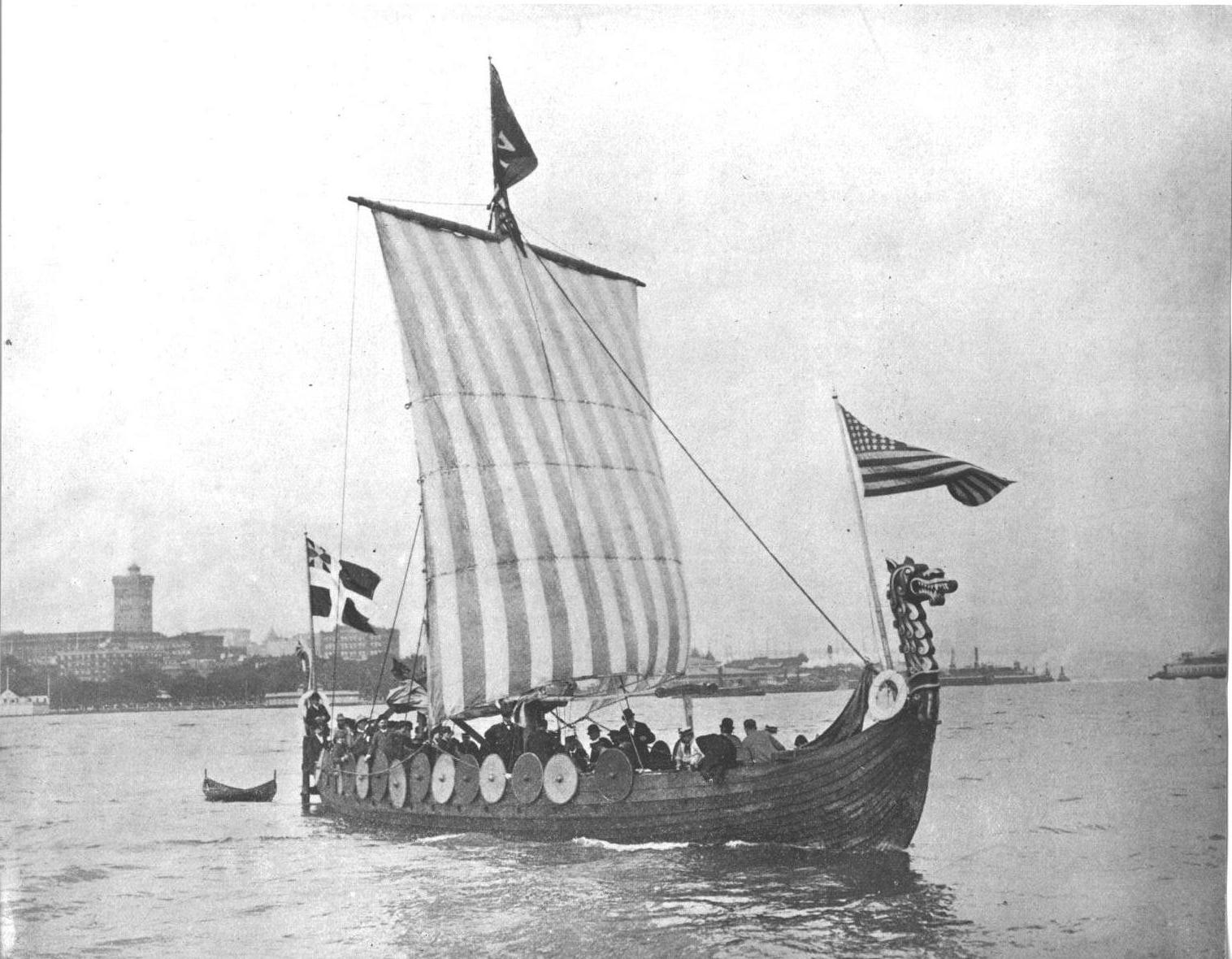
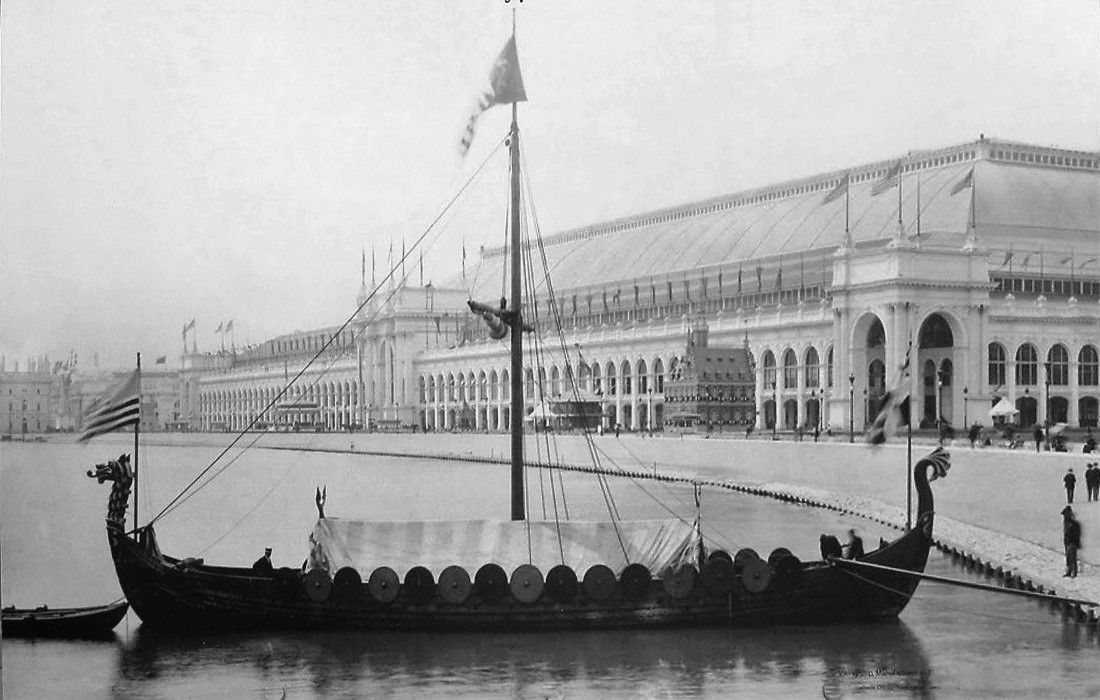
As beautiful as the ceremonial grandeur of the Oseberg was, the simple grace of the Gokstad was the ship at the Viking Ship Museum that took my breath away. Intuitively, this longship looked more seaworthy than the Oseberg. I later learned that in 1893 a full-scale replica of the Gokstad successfully completed a 44-day voyage across the Atlantic Ocean from Bergen, Norway to Chicago for the World’s Columbian Exposition. 

Image: http://www.danstopicals.com/gokstad.htm 

Ironically, the exposition was held in celebration of Christopher Columbus’ discovery of the western hemisphere in 1492. In a move that predated the term “political correctness”, in order to minimize offending the Columbian Exposition, the ship’s proposed name “Leif Ericson” was rejected in favor of “The Viking”.

Image: Wikipedia 


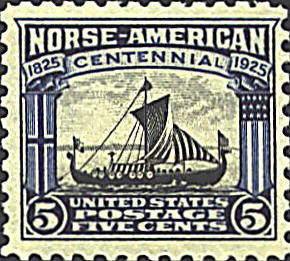
In 1925 a stamp commemorating the Norse-American centennial depicted the Gokstad’s replica, complete with the American flag at the bow and the Norwegian flag at the stern.

Image: danstopicals.com


* * *

Both the Oseberg and the Gokstad were built using the clinker method where the oak planks overlapped along the edges. The Gokstad is slightly bigger. 


Ship
Length
Width
Oseberg
21.58 meters (70.8 feet)
5.10 meters (16.7 feet)
Gokstad
23.24 meters (76.25 feet)
5.20 meters (17.1 feet)


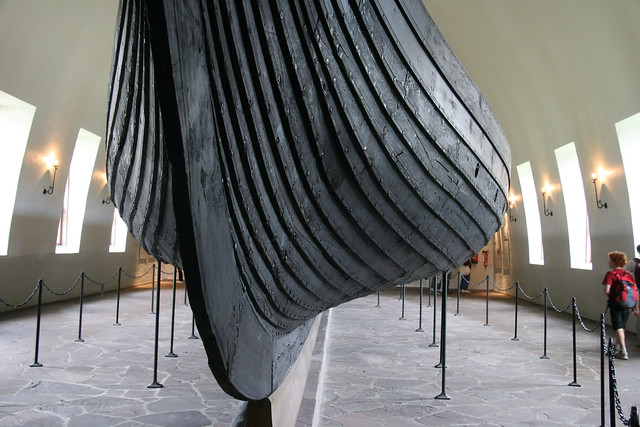
IMG_2606  Gokstad Ship


A single piece of oak was used to ensure the structural integrity of the keel.The length of the keel then determined the dimensions of the rest of the ship. I imagine that the tallest and straightest oaks in the land would be a Viking boat builder’s greatest treasure.

IMG_2618 Gokstad Viking Ship


The invention of the keel is one of the key reasons for the Vikings maintained naval superiority for over two hundred and fifty years. A keel allowed the ship to be rowed and sailed as well. The smaller draught, along with a removable rudder, the ship had the distinct advantage of being able to navigate in shallow inland waters.

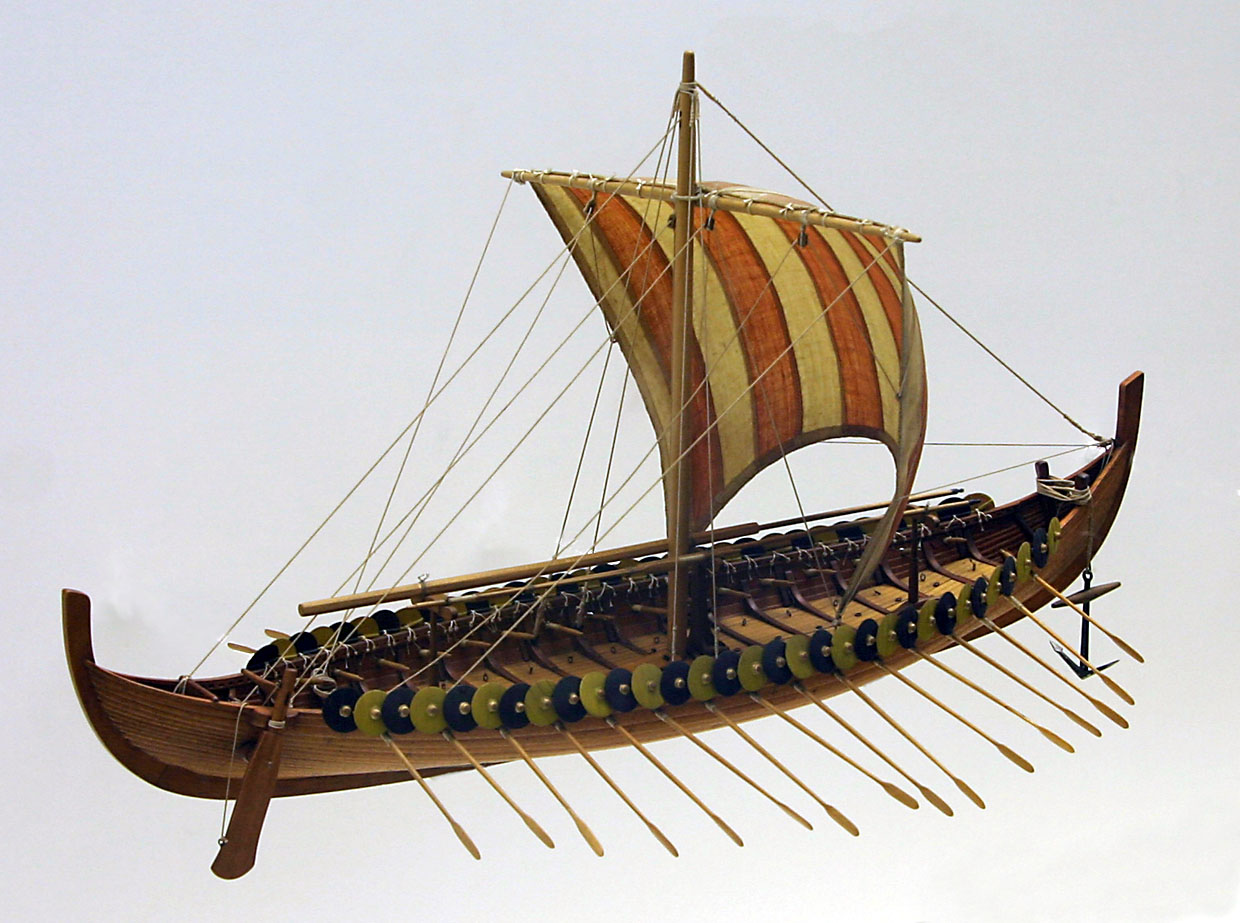
Remnants of 32 shields, alternately painted black and yellow, along with 16 oars for each side, and a striped woolen sailcloth were excavated from the buried ship. There were no benches, thus it is speculated that the oarsmen sat on their sea chests.


Model of the Gokstad ship
 Image: Wikipedia


Like the Oseberg, the Gokstad was used as a burial chamber. A 50- to 70-year-old male was uncovered with the ship along with some modest grave goods. It is believed that the valuable items were plundered long ago.


IMG_2607 Gokstad Viking Ship


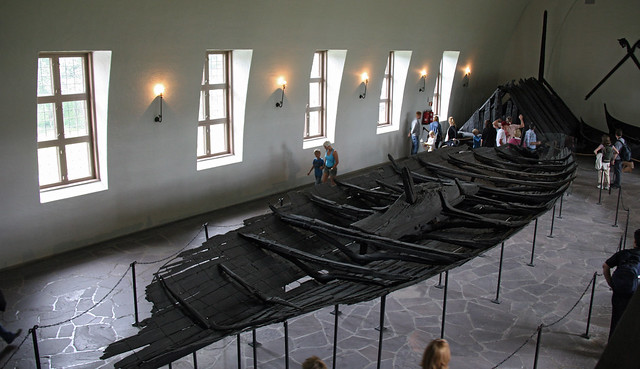
The third ship at the Viking Ship Museum is a 22-meter fragment of the Tune ship.


IMG_2602 Tune Ship

The incomplete state of this ship reminds us how remarkable the nearly complete finds of the Oseberg and Gokstad were.

Monday, September 13, 2010

Macro Monday - Oseberg Detail

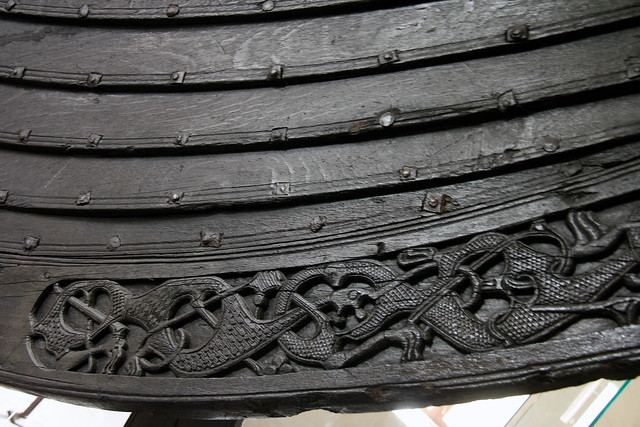
IMG_2597 Oseberg detail


When I was trolling through reviewing my Norway photos for my next post, I ran across this detail of the Oseberg ship. I rejected it for the post I wrote because it was out of focus. I like how the photo shows off the original rivets and the craftsmanship of the woodcarver.  I decided to fiddle around with the sharpen settings in PhotoShop and came up with this. It's still not great, but what do you think? You can see it larger here. Should I have published this? Here's the original picture; click to enlarge it.


Wednesday, September 8, 2010

The Viking Ship Museum in Oslo - Oseberg Excavation

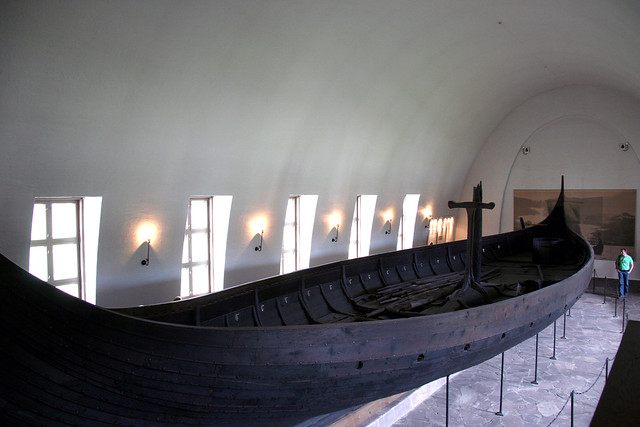
IMG_2585 Oseberg Viking Longship

During our stay in Oslo, we ferried over to Bygdøy peninsula where we spent the day visiting several impressive cultural and historical museums. The Oslo Pass proved to be a great investment because it was accepted on the public ferry to Bygdøy and at all the museums here.

The Viking Ship Museum was a great treat for my brother-in-law because, like his father did, he works on the San Francisco Bay every day. We say that he has salt water running through his veins, no doubt a trait that passed down from his Norwegian ancestors.

The Oseberg Viking Longship

The Oseberg Viking longship is the world’s most complete ship ever found. A farmer discovered the ship in 1903 while he was digging in a mound on his farm. The following summer, Swedish archeologist Gabriel Gustafson led an excavation team for five months until the last piece of the the 70-foot longship was unearthed. The blue clay of the mound preserved the wood for longer than a millenium.

Image: Univeristy of Oslo 

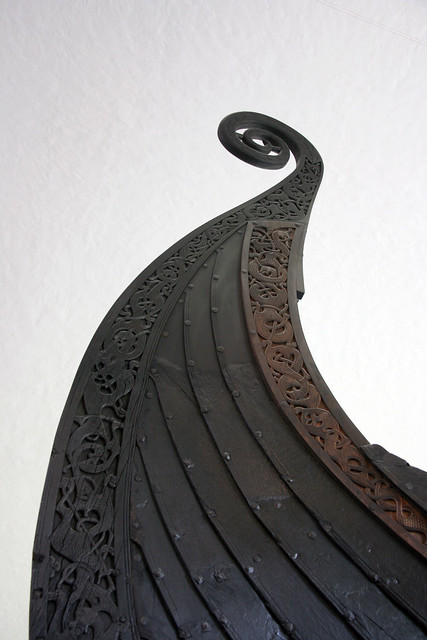
It was determined that the ship dates from before the year 800 and that she was buried since 834. Conservators spent twenty-one years meticulously restoring the ship using almost all of the original wood and even many of the original iron rivets. Unfortunately, the conservation method of boiling the oak in a concentrated solution of alum rendered the wood brittle as crisp bread. In 1926, the delicate ship was moved to her new, custom-made home where she still stands today.

Image: Univeristy of Oslo 
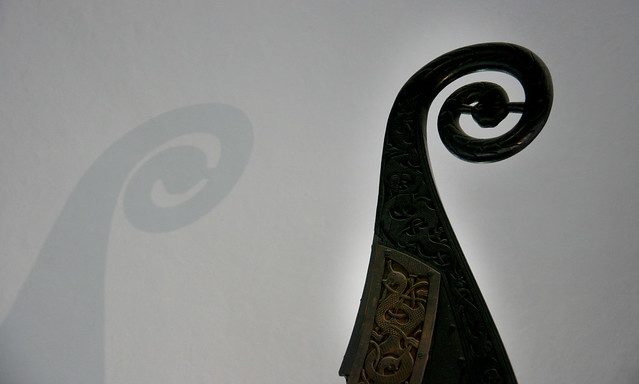
She is housed in the first room of the Viking Ship Museum which is bathed in a beautiful blend of natural and understated man-made lighting with a ceiling that is shaped like an upside down ship hull. As I was taking the photo at the top of this post, my son sidled up next to me and suggested that I take a couple of steps to the left. Then I saw what he saw...

IMG_2584 Oseberg Viking Longship

...a shadow twin.

IMG_2588 Oseberg Viking Longship with shadow twin

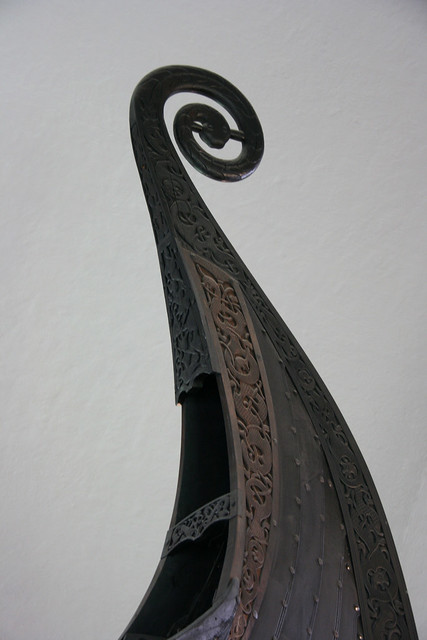
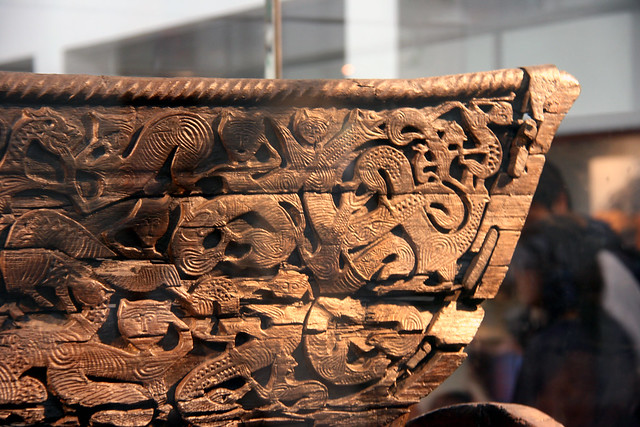
The frond-like prow ...

IMG_2590 Oseberg Viking Longship

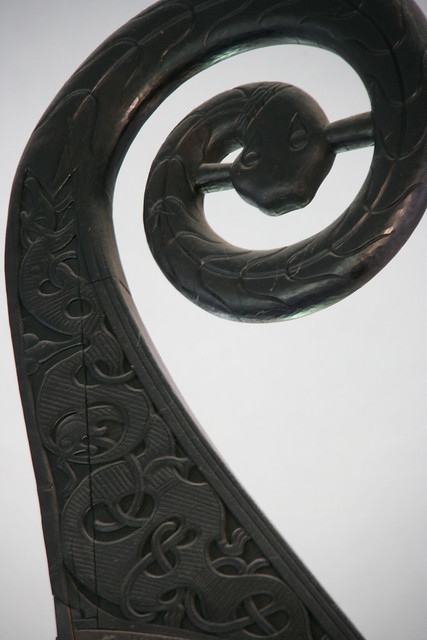
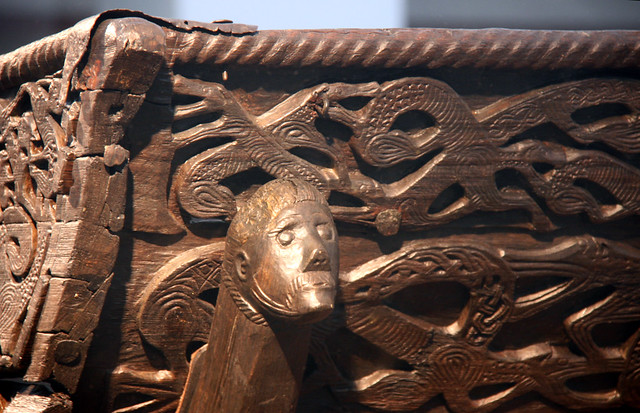
.... turned out to be the head of a serpent...

IMG_2587 Oseberg Viking Longship

... with its body intricately carved along the keel and terminating with  its tail at the stern:

IMG_2592 Oseberg Viking Longship

A giant serpent emerging out of the fog would feed any fears and “confirm” numerous sightings of legendary sea monsters.

The Oseberg was thought to only be seaworthy enough for coastal voyages. A full-scale copy of the ship sank in the Mediterranean Sea during trials in 1987. The New Oseberg Ship Foundation hopes to make new replica.

The Oseberg's elaborate ornamentation suggests its use as a ritual vessel and, in fact, the ship was used as a burial chamber. When found, it contained the remains of two women with livestock and objects to be used for the afterlife. The opulence of the grave goods in the ship and the attire of the women suggested  that at least one of them was of very high status. They even unearthed the remains of a peacock which must have been an exotic pet.


The Oseberg Cart

The women were reburied in the original Oseburg mound, but many of the artifacts are on display in the museum. The extravagantly-carved Oseberg cart is the oldest known vessel with wheels in Norway.


IMG_2608 Viking Museum cart

It is believed that the artist who carved the decorations of the Oseberg ship also executed the carvings on the cart. The front of the cart depicts a pit of snakes...

IMG_2611 Viking Ship Museum cart

...surrounding a man believed to be Gunnar in the snake pit of Viking mythology. 

IMG_2614 Viking Museum cart detail

Gunnar was chained and thrown into a pit of snakes but played a harp with his toes so well that all but one snake were lulled to sleep. Tragically, the final adder killed him.

Wednesday, July 1, 2009

Jesuit Church of New Orleans


The only thing that is more fun than eating jambalaya and beignets, is visiting with our many relatives New Orleans. We shared several memorable meals with cousins, aunts, uncles, and nephews and we attended Sunday mass with George Schiaffino, his wonderful wife and their precious baby. George is not one to get up early to attend Sunday morning mass in the heat of day, so he chooses to attend the 7:30 Sunday evening mass. Given that we were still operating on California time, we were grateful to accept George’s invitation to join him at the historic Immaculate Conception Jesuit Church, or simply "Jesuit Church" as it is popularly known.

The history of the French Jesuits in New Orleans dates back to the time when La Salle claimed the Territory of Louisiana for France in 1682. The Jesuits evangelized the Native American nations in the Mississippi Valley and New Orleans became the headquarters for the mission.

In 1725, with the help of the founder of New Orleans, Jean Pierre Lemoine Sieur de Bienville, the Jesuits gained permission from King Louis to develop the Louisiana Territory. After outgrowing a home in the heart of the French Quarter, they grew sugar, tobacco and oranges on the “Jesuit Plantation”, situated on a water-covered cypress swamp two blocks upriver from the French Quarter.

By 1763, the Jesuits enjoyed great power throughout the world, but in 1773 their influence came to an end when Pope Clement XIV signed a decree to suppress the Order. Every Jesuit priest and brother was ordered back to France. Jesuits did not return to New Orleans until 1837.

In 1846, Jesuits from Lyons, France purchased the same property where the plantation stood for $22,000. Friar John Cambiaso erected two buildings which served as a college, residence, and church. His love for Moorish architecture is reflected throughout the buildings:

DSC06491 Jesuit Church Moorish details

DSC06483 Jesuit Church rosette window


The first mass at The College of the Immaculate Conception was offered eleven years later. Despite heroic efforts to reinforce the swamp-based foundations, the buildings were declared structurally unsafe 71 years later in 1928. The church was dismantled, brick by brick, while meticulous records were kept. Here is a heartbreaking excerpt:

“The historic statue of Our Immaculate Mother that has stood for over half a century in the resplendent niche above the golden altar is taken down today, July 26, 1928. The workmen laid it on a little truck and rolled it to a storage place next door. The scene was very sad and looked like a depressing funeral. I pray that our glorious Queen of Earth and Heaven may soon rise again and be placed on a throne more beautiful than the one from which she has just been removed, owing to dire necessity”.


DSC06485 Jesuit Church Mary's niche

“Mary’s statue is solid marble. She was hand carved by Denis Foyatier, who carved Our Lady out of the purest marble. The statue of Mary stands there in the serene simplicity like a mother beckoning her children to come closer and to be in peace. The statue is bathed in light with a beautiful gold background."

First mass was said in the new Immaculate Conception Church on March 2, 1930.


The Main Altar (Opening photo) “This altar was built in 1867 of gilded bronze and won first prize in the Paris Exposition of 1867. The altar was designed by James Freret of New Orleans, but was constructed in Lyons, France. There are more than 600 pieces to this altar. The Moorish domes on top of the altar as well as the miter-shaped arches all harmonize perfectly with the architecture of the entire building.” Four Saints Under Mary’s Niche St. Stanislaus – A model and mirror of religious perfection St. Francis Xavier – Great missionary to India and Japan St. Ignatius - The founder of the order of the Society of Jesus (not shown) St. Aloysius – Patron of youth, devoted to the care of the sick (not shown) 


DSC06486 Jesuit Church St F Xaverius St Stanislaus

Mosaic Shrines This is one of two mosaics commissioned in Italy in 1930. It celebrates Mary under the title of Our Lady of Prompt Succor as she miraculously granted =two appeals of help= from the nearby Ursuline nuns:


“The original (Ursuline) building was riddled with problems caused by the climate, soil, and weather conditions. The present building was completed around 1752. Here, the legend of the city's patroness, Our Lady of Prompt Succor, was born. In 1788, a great fire swept away the hundreds of homes and also threatened the convent. Sister St. Anthony, one of the old nuns, climbed the convent stairs carrying the small statue of Our Lady. As the Superior watched, Sr. St. Anthony set the statue on the sill facing the fire, then knelt and prayed with great confidence. At that very instant the wind veered and the flames were blown back.”
“The night before the Battle of New Orleans in the War of 1812, nuns and relatives of the men fighting with Andrew Jackson’s forces spent the night in prayer before the statue of Our Lady of Prompt Succor. Miraculously, the badly outmanned and underequipped Americans defeated the British. In keeping with a vow made that day, a Mass is celebrated every January 8th in thanksgiving. The miraculous statue is presently at home in the National Shrine of Our Lady of Prompt Succor, at the Ursulines latest home.”


”DSC06495


If you are in New Orleans on a Sunday evening, you may be interested in attending Jesuit Church for the 7:30 p.m. mass. Chances are good that George Schiaffino will be one of the readers at the pulpit. Please let him know that you read about him at dutchbaby’s. Most of the hystorical information from here.
Related Posts Plugin for WordPress, Blogger...
Bookmark and Share